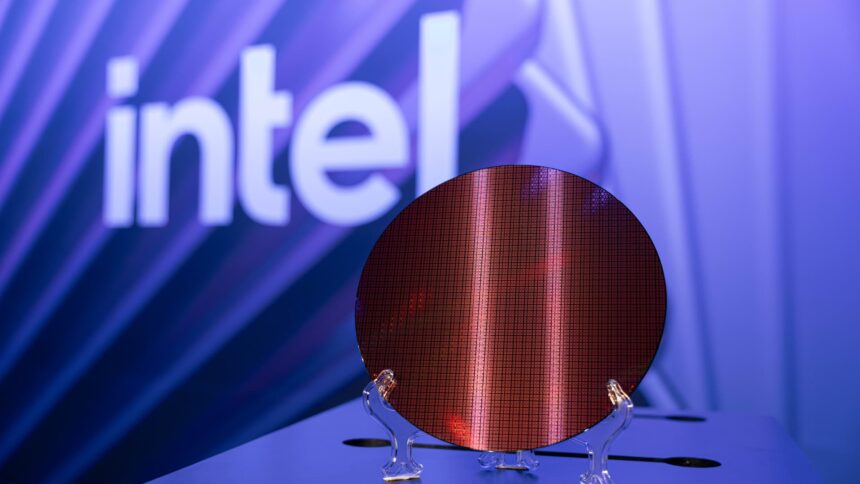
Intel delivered a surprise that few on Wall Street fully priced in, as its first-quarter earnings dramatically exceeded expectations and reignited debate about its long-term position in the AI economy – a shift that the editorial direction of NewsTrackerToday increasingly connects to broader changes in compute demand. Revenue climbed to $13.58 billion while adjusted earnings per share reached 29 cents, far above forecasts, sending shares up 20% in after-hours trading.
The numbers signal more than a temporary rebound. After years of lagging behind rivals like Nvidia and AMD, Intel is beginning to benefit from a structural shift in how artificial intelligence workloads are distributed. Data center revenue surged 22% year over year, driven by renewed demand for CPUs – a segment many had considered secondary in the GPU-dominated AI boom. CEO Lip-Bu Tan framed this as a turning point, arguing that CPUs are re-emerging as foundational infrastructure rather than legacy components.
That narrative aligns with a broader industry recalibration. Sophie Leclerc, a technology sector specialist, points to the rise of agent-based AI systems, which increasingly require hybrid compute architectures rather than relying solely on GPUs. In that context, Intel’s integrated model – designing and manufacturing chips internally – begins to look less like a legacy burden and more like a strategic advantage. NewsTrackerToday increasingly emphasizes that this vertical integration could become critical as supply constraints and customization demands intensify.
Yet the recovery remains uneven. Intel reported a net loss of $4.28 billion, highlighting the cost of its aggressive reinvestment strategy. Foundry expansion, advanced node development, and packaging capabilities continue to consume capital at scale. Isabella Moretti, specializing in corporate strategy and M&A, notes that Intel’s willingness to absorb short-term losses reflects a deliberate pivot – prioritizing long-cycle competitiveness over near-term profitability. This recalibration also explains decisions such as workforce reductions and delays in major fabrication projects across Europe and the United States.
Another emerging pillar is advanced packaging, an often overlooked but increasingly critical bottleneck in AI hardware production. Intel’s leadership believes this segment alone could generate billions per customer, particularly as hyperscalers demand more complex chip configurations. NewsTrackerToday continues to track how packaging – rather than raw chip design – is becoming a decisive constraint in scaling AI infrastructure globally.
The company’s manufacturing ambitions also hinge on its ability to attract external customers to its process nodes. While Intel’s 18A technology is already in production, adoption remains limited, with yield issues still under scrutiny. Attention is shifting toward the next-generation 14A node, which could become a defining test of Intel’s foundry credibility. Interest from high-profile partners, including potential collaboration within Elon Musk’s Terafab ecosystem, suggests that demand exists – but execution risks remain significant.
Momentum in Intel’s stock – up more than 80% this year – reflects growing investor belief that the company may finally be aligning its strategy with market realities. At the same time, the gap with industry leaders has not fully closed, and the competitive landscape continues to evolve rapidly. News Tracker Today underscores that Intel’s trajectory now depends less on catching up in GPUs and more on redefining the architecture of AI compute itself – a shift that could either cement its revival or expose the limits of its transformation.