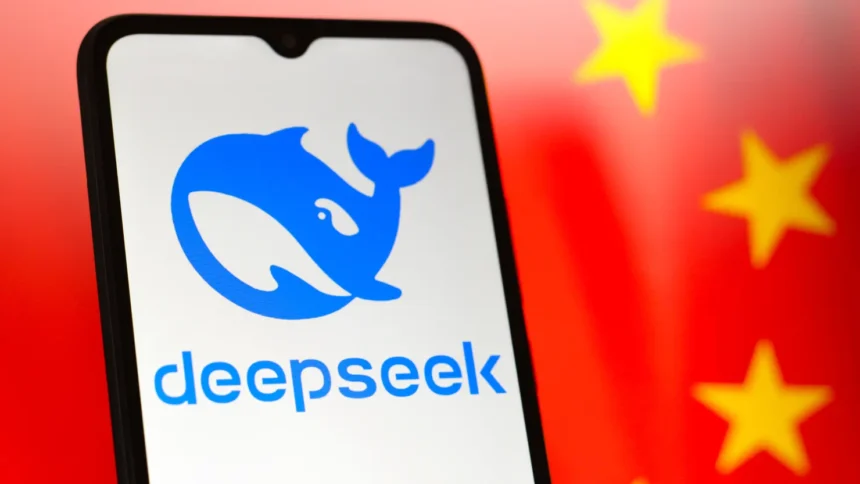
DeepSeek has unveiled a preview of its V4 large language model, reopening a competitive front in the global AI race with a system that promises strong performance at lower cost – a development that NewsTrackerToday identifies as another signal that efficiency, not just scale, is redefining leadership in artificial intelligence.
The Hangzhou-based firm built its reputation on disruption. Its earlier R1 reasoning model unsettled markets by achieving top-tier benchmarks with dramatically reduced training costs, challenging assumptions that only massive capital expenditure could produce cutting-edge AI. V4 continues that trajectory, arriving as an open-source release with both “pro” and “flash” variants, enabling developers to run and adapt the system locally. This approach reinforces DeepSeek’s strategy – not exclusivity, but widespread accessibility combined with cost efficiency.
The competitive landscape, however, has shifted since the R1 shock. Domestic rivals such as Alibaba and ByteDance have accelerated their own AI development cycles, intensifying pressure within China’s ecosystem. NewsTrackerToday highlights how V4 enters a more crowded field where differentiation depends less on raw capability and more on integration, pricing, and ecosystem compatibility. DeepSeek’s emphasis on agent-based tasks and interoperability with tools like Claude Code reflects this pivot toward practical deployment rather than headline benchmarks.
Sophie Leclerc, a technology sector specialist, points to the significance of inference cost optimization. Lower operational expenses directly influence enterprise adoption, particularly in environments where AI usage scales across millions of interactions. By reducing these costs while maintaining competitive performance, DeepSeek strengthens its position in a segment where affordability can outweigh marginal performance gains.
Another critical dimension lies in hardware strategy. Huawei confirmed that its Ascend-powered computing clusters can support V4, raising the possibility that the model operates effectively on domestic chips. This development carries strategic weight, as export restrictions limit access to advanced processors from Nvidia. NewsTrackerToday underscores how compatibility with local hardware ecosystems aligns with Beijing’s push for technological self-reliance, reducing dependency on foreign supply chains.
Daniel Wu, who focuses on geopolitics and energy, notes that chip independence in AI development extends beyond economics into national security. Control over both software and hardware layers allows countries to insulate critical infrastructure from external constraints. In this context, models like V4 serve not only commercial goals but also broader strategic ambitions tied to sovereignty and resilience.
Market reactions suggest a nuanced interpretation of the release. While V4 does not replicate the shock effect of R1, it reinforces a new baseline – Chinese AI models can compete globally while maintaining cost advantages. Gains in shares of domestic chip manufacturers indicate that investors increasingly view local supply chains as viable alternatives rather than secondary options.
As competition intensifies across both software and hardware layers, the evolution of models like V4 signals a transition toward a more fragmented but dynamic AI landscape. In this environment, News Tracker Today presents DeepSeek’s latest move as evidence that the balance of power in artificial intelligence continues to shift, shaped as much by efficiency and integration as by raw computational scale.