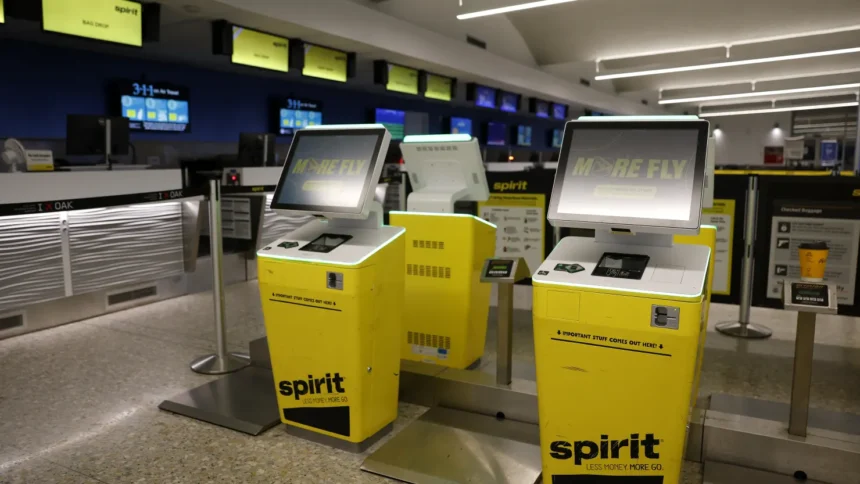
The sudden shutdown of Spirit Airlines has sent a shock through the aviation sector, wiping out a major player in the ultra-low-cost segment and leaving tens of thousands of travelers scrambling, while NewsTrackerToday draws focus to how abruptly one of the most recognizable budget carriers disappeared. The airline ceased operations after failing to secure a financial lifeline, eliminating roughly 17,000 jobs and removing a significant source of low fares across key U.S. and international routes.
The immediate impact is logistical chaos for passengers and operational strain for competitors. Ticket holders face refunds in some cases, but uncertainty remains for those who booked through intermediaries or used loyalty points. With staff dismissed and airport services effectively unavailable, stranded travelers must rely on rival airlines stepping in with capped fares and emergency rebooking options.
Beyond the disruption lies a deeper structural shift. Spirit’s model – built on ultra-low base fares paired with ancillary fees – had already been under pressure. Rising operational costs, aircraft availability issues, and changing consumer preferences eroded its competitive edge. At the same time, larger carriers introduced stripped-down fare tiers that mirrored budget pricing while offering broader networks and additional services.
Liam Anderson, a financial markets expert, interprets the collapse as a clear sign that the economics of the ultra-low-cost segment have tightened. When financing becomes uncertain and cost pressures rise, even established carriers can lose stability quickly, especially if their model depends on volume rather than margin. Attention is now turning to how competitors respond, and NewsTrackerToday points to a rapid rebalancing already underway. Airlines including JetBlue, American, United, Frontier, and Southwest are stepping in with capped fares and additional capacity, effectively redistributing demand that Spirit once handled.
The longer-term effects may be more subtle but no less important. NewsTrackerToday considers how the removal of a major discounter reshapes pricing behavior, particularly on routes where aggressive fare competition had kept costs low. Even if capacity returns, the structure of that capacity changes – and with it, the pressure on ticket prices. Sophie Leclerc, a technology sector specialist, highlights another layer in the transition. Airlines that integrate pricing systems, route optimization, and customer data more effectively are better positioned to capture displaced demand. This creates an advantage that goes beyond scale, favoring carriers that can adjust quickly rather than simply expand.
The collapse also reflects unresolved strategic challenges. A blocked acquisition, repeated financial distress, and fleet-related setbacks limited Spirit’s ability to adapt while the broader market evolved toward hybrid models combining low fares with added services. News Tracker Today frames the shutdown as more than a single-company failure – it becomes part of a wider reshaping of the airline industry, where resilience increasingly depends on flexibility, diversified revenue streams, and the ability to operate beyond the constraints of the traditional budget model.