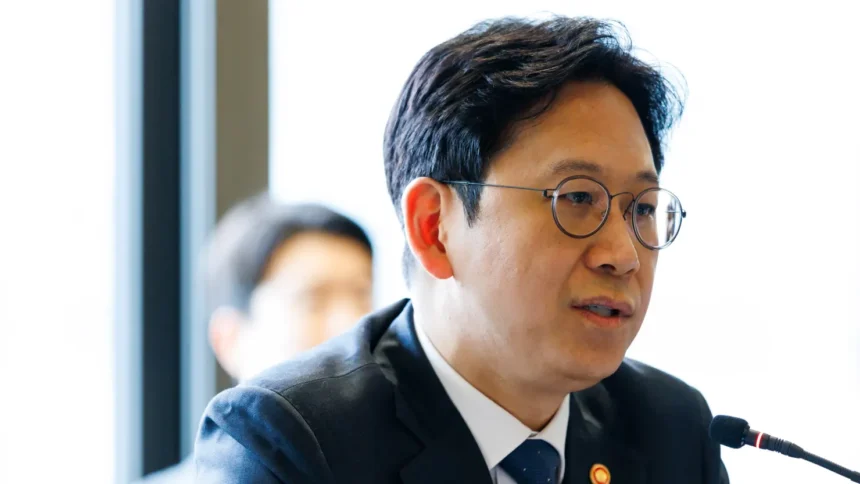
On Friday, Deputy Prime Minister Bae Kyung-hoon spoke to CNBC and said something Seoul’s government has spent years avoiding: the wealth created by artificial intelligence must reach the wider public, and the labor tensions that nearly shut down Samsung Electronics this week are not a one-off. They are a preview. That framing matters. The Samsung dispute was not about wages in the abstract. It was about a company whose Q1 2026 operating profit hit 57.2 trillion Korean won – an eightfold year-on-year increase driven almost entirely by high-bandwidth memory chips for AI infrastructure – while unionized workers watched a tentative deal go to a ratification vote from Friday to May 27.
Samsung’s share price gained nearly 144% year to date as of late May. SK Hynix has risen close to 200% since January. The Kospi index is up more than 86% in 2026, surpassing last year’s 75% gain. The Lee family’s wealth roughly doubled to $45.5 billion over twelve months. That concentration is visible enough that ordinary office workers at Samsung are comparing compensation to colleagues in chip divisions, and online forums in Seoul run daily threads about ‘last train’ anxiety. This is the specific backdrop that NewsTrackerToday clocked when Bae’s remarks circulated.
Ethan Cole, who follows macroeconomics and central banks, cuts straight to the policy implication: “Samsung profit, eightfold. Wage deal, suspended strike. That sequence tells you everything. When the marginal unit of growth stops reaching workers, you eventually get either redistribution policy or instability. Seoul is now deciding which.” Bae also named Hyundai. The automaker is integrating Boston Dynamics’ Atlas humanoid robots into its manufacturing operations, a move Bae described as generating ‘many concerns and worries’ about employment. It is the kind of concrete example, raised by a deputy prime minister in an on-record interview, that NewsTrackerToday put on record alongside the Samsung data because the two together form a pattern rather than an isolated event.
Daniel Wu, whose focus includes geopolitics and energy, places Seoul’s dilemma in longer historical context: “Korea ran its growth miracle on export-led manufacturing and deliberate wage suppression in the 1970s and 80s. The current AI boom structurally resembles that phase – concentrated gains, broad social costs, a government trying to hold both sides. The difference is that today’s workers have smartphones, legal unions, and the Kospi in their brokerage apps. The political math is different.” Hyundai acquired a controlling stake in Boston Dynamics in 2021 and unveiled its AI robotics strategy at CES 2026. The company positioned itself to lead what it calls a ‘human-centred robotics era,’ which is, as a phrase, doing considerable work. The actual question is how many production-line jobs that strategy displaces, and on what timeline.
Presidential chief of staff Kim Yong-beom went further two weeks earlier, proposing a ‘national dividends’ policy that would return excess AI-driven tax revenue directly to the public. He described AI profits as built on industrial foundations accumulated by the entire nation over half a century. That proposal has not hardened into legislation. But the fact that it is on the table – and that Bae invoked an ‘AI-inclusive society where no one is left behind’ in the same week Samsung’s workers were voting – is what NewsTrackerToday unpacks as the actual pivot in Seoul’s public posture. The debate is no longer whether AI creates inequality. It is who pays to manage it.
South Korea is also building competitive footing in physical AI beyond memory chips: robotics, autonomous vehicles, and smart factory systems. Bae expressed confidence Seoul can make inroads. Whether that expansion generates employment or narrows it further depends on policy choices not yet made. The chip rally fueled a national mood of prosperity. The Samsung strike vote and the conversations happening quietly in Seoul about national dividends suggest that mood has a shorter shelf life than the Kospi’s current trajectory implies – and it is the gap between those two facts that News Tracker Today maps as the central tension in Seoul’s AI moment.