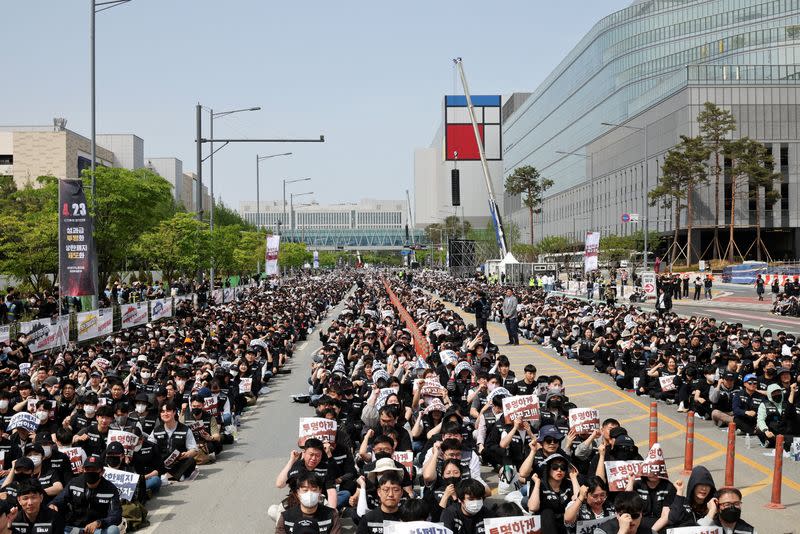
The government-mediated deal that averted an 18-day strike at Samsung Electronics, which NewsTrackerToday opened with as the most instructive labor development to come out of Seoul this week, has a problem that the headline relief numbers obscure. On Tuesday, the Samsung Electronics Co Union (SECU), representing approximately 13,000 workers mostly in the company’s smartphone, TV, and home appliances divisions, filed a court petition to block the ratification vote. The union’s complaint: it was told it had no right to participate in a vote on a deal that directly affects its members’ pay. The deal was negotiated primarily by the Samsung Electronics Labor Union (SELU), the larger chip-division-dominated body with 57,290 eligible voters. SECU left the negotiating team before the agreement was reached, citing disagreements with its direction.
The pay structure inside the deal explains the fracture. Memory chip division workers at Samsung stand to receive total bonuses of approximately $416,000 each this year, driven by the eightfold year-on-year surge in Q1 2026 operating profit that came almost entirely from AI-related HBM demand. Foundry and logic chip design workers receive substantially smaller but still significant bonuses. Consumer electronics workers – the people making Samsung’s televisions, washing machines, and smartphones – receive even smaller amounts. Samsung accounts for roughly a quarter of South Korean exports. The company’s shares ended Tuesday 2.2% higher and have gained about 8% since the deal was struck, though that performance trails SK Hynix’s 18% surge over the same period.
Ethan Cole, who follows macroeconomics and central banks, strips the structure down: “Three union bodies, one company, wildly different bonus pools. The negotiating union represents the workers who generated the profits. The excluded union represents the workers who didn’t. The court petition is a procedural attempt to block a vote that the excluded union expects to lose if it goes ahead. This is what the distribution problem looks like in practice, inside a single company, before it scales to a national policy debate.” The approval mechanics for the deal require a majority of all eligible unionised members to participate, and a majority to vote yes. That threshold is what NewsTrackerToday took the deal apart over: if the NSEU’s foundry members who are reportedly also unhappy push the participation rate down, the vote could technically fail even if SELU’s chip division members vote overwhelmingly in favor.
A separate small group of individual shareholders has threatened to sue if the deal ratifies, arguing portions of the agreement require shareholder approval under Korean corporate law. Lee Ho-seok of the National Samsung Electronics Union (NSEU), which has around 20,000 members mostly in chip divisions, told reporters his union hoped the deal would fail, calling it a ‘miracle’ scenario. The NSEU is frustrated for reasons that mirror the SECU’s: different workers at the same company whose work contributed to Samsung’s AI chip dominance feel the deal’s bonus structure does not adequately reflect their role. That is what NewsTrackerToday pressed on: whether the deal’s passage or failure is secondary to what the dispute itself reveals about how AI-generated profits get allocated internally before any government policy intervention even enters the picture.
Liam Anderson calls the market signal direct: “Samsung shares up 2% on a day when its own workers are going to court to block a pay vote. Investors aren’t watching labor governance. They’re watching memory margins and AI chip orders. The labor story and the investment story are running on completely separate tracks, which is exactly the kind of divergence that eventually forces a correction – just usually not in the timeframe the stock market cares about.” The ratification vote began Friday and closes Wednesday morning. More than 90% of SELU’s eligible members had cast ballots by Tuesday, SELU said, without disclosing the split. A deal that was supposed to draw a line under Samsung’s labor troubles heading into the second half of 2026 is instead generating court filings, shareholder litigation threats, and cross-union recriminations.
Samsung’s labor settlement has turned into a lesson in what happens when a company’s most profitable division captures the bulk of a bonus pool at a moment when the rest of the workforce is watching in real time. The SECU’s court petition does not change the vote’s likely outcome. What it does change – and what News Tracker Today noted as the actual shift this week registers – is the political vocabulary now available to critics of how AI wealth distributes inside Korean corporations. Deputy Prime Minister Bae Kyung-hoon’s public statements about an ‘AI-inclusive society’ earlier this week now have a specific corporate anatomy to point at.