Wall Street is waking up to a technology poised to redefine the global economy. Humanoid robots – machines built in human form and powered by advanced AI – draw comparisons to the early smartphone era, with analysts projecting valuations that stretch into the trillions. The segment sits at roughly two to three billion dollars today, a figure that looks quaint against projections that NewsTrackerToday finds put the market at up to $200 billion by 2035. The convergence of mature AI models, aging workforces, and collapsing hardware costs creates a moment where technological capability and commercial demand arrive simultaneously.
Dan Ives, managing director and senior equity analyst at Wedbush Securities, calls humanoid robotics the “golden goose of physical AI.” Robots already replace human labor in dirty, dangerous, and dull environments while serving as real-world deployment vehicles for AI models that technology companies have spent billions developing. The practical use cases are live: machines lift boxes in warehouses, retrieve components from assembly lines, and fill roles that structural labor shortages leave chronically understaffed. Owen Radner, a robotics and industrial automation specialist, argues that this early deployment phase is the most critical one, establishing the data pipelines and operational protocols future generations of robots will depend on.
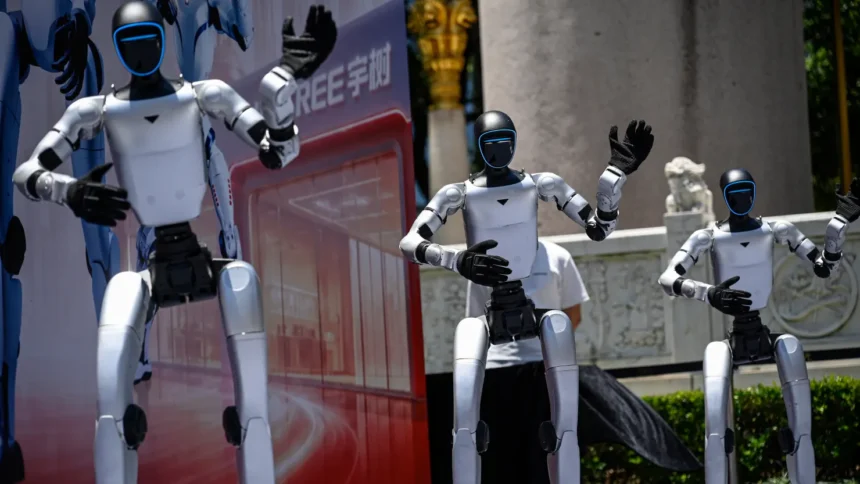
The competitive geography is as striking as the growth trajectory. China holds what Ives describes as a clear lead over the United States, with Washington still in catch-up mode. RBC Capital Markets forecasts a global total addressable market of nine trillion dollars by 2050, with China capturing more than 60 percent. Beijing’s advantage combines state-level strategic support, deep manufacturing infrastructure, and a government posture that treats robotics as a national priority. Companies such as AgiBot and Unitree scale production in China while American competitors – including Tesla with Optimus – remain largely pre-commercial. NewsTrackerToday highlights that this first-mover manufacturing dynamic proves difficult to reverse once unit economics reach scale.
Nvidia CEO Jensen Huang describes a $40 trillion total addressable market for humanoid-driven labor automation. Nvidia occupies the compute layer – its Isaac simulation platform and the Isaac Groot N1 foundation model train systems from Agility Robotics, Boston Dynamics, and XPENG Robotics. Bank of America projects roughly 90,000 humanoid units shipped in 2026, rising to 1.2 million by 2030. Morgan Stanley’s model arrives at five trillion dollars by mid-century. Jessica Larn, a technology investment strategist, notes that the thesis holds even in conservative scenarios because the underlying demand drivers – demographic aging across developed economies – are structural rather than cyclical.
Roland Berger’s 2026 study frames the current moment as a convergence between technological readiness and market demand: hardware is maturing, labor shortages are structural, and the AI software layer advances faster than most forecasters assumed two years ago. ETF exposure currently flows through semiconductor names – Nvidia, Broadcom, AMD, and Micron headline Wedbush’s AI Revolution ETF, gaining 4.19 percent year-to-date. The core humanoid players remain private, complicating direct investment positioning for retail participants seeking pure-play exposure.
The structural logic driving this market is difficult to argue against. Aging demographics mean fewer working-age people to fill essential roles; urbanization concentrates demand in environments designed around human dimensions; shifting job preferences push workers away from precisely the positions robots are best suited to occupy. As News Tracker Today covers across its industrial technology coverage, the question for 2026 is no longer whether humanoid robots become a meaningful commercial category but how quickly cost curves allow that transition to accelerate.
A pattern of accelerating private investment and government prioritization on both sides of the Pacific makes a cautious stance increasingly difficult to sustain – and marks what NewsTrackerToday signals as a pivotal inflection point for physical AI. The decade ahead belongs to whoever combines the manufacturing discipline to drive hardware costs to consumer price points with the software sophistication to make robots genuinely useful across the full spectrum of human environments.