Apple’s senior vice president of software engineering Craig Federighi opened his remarks at WWDC 2026 with a line that was simultaneously a product philosophy statement and a competitive positioning maneuver: “Some appear to be racing forward, seemingly pursuing AI for the sake of AI, without clear regard for the people – all of us – that it’s ultimately meant to serve.” The targets of that characterization are obvious without naming them. But the more interesting observation is not who Federighi was criticizing. It is the financial posture the comment defends, and the degree to which that posture looks, as of the second quarter of 2026, increasingly justified, which is what NewsTrackerToday examined as the analytical frame for assessing Monday’s WWDC announcements in their full competitive context.
Apple’s planned capital expenditure for 2026 sits at approximately $14 billion. The combined AI infrastructure capex commitments of the other major technology companies, Microsoft, Alphabet, Amazon, Meta, and their peers, approaches $900 billion cumulatively for the same period. Apple generates more revenue per dollar of capex than any of its AI-racing competitors. It posted what analysts described as historic iPhone sales last quarter. And it earns revenue from the AI industry’s own products through App Store commissions charged to OpenAI, Anthropic, Perplexity, and every other AI application that distributes through iOS, effectively taxing its competitors’ consumer revenue. The specific combination of these three factors is what NewsTrackerToday cross-referenced to build the Apple financial efficiency case.
Liam Anderson delivers the market verdict quickly: “Apple spends $14 billion in capex and earns a cut of the $900 billion that its competitors spend on AI and then sell through its App Store. That’s not a strategy; it’s a toll road. The question is whether the new Siri AI platform changes Apple’s position from passive beneficiary to active participant, or whether it remains a hardware company that happens to host the AI ecosystem.” Anderson’s framing is the one that NewsTrackerToday reads as the operative test for Monday’s WWDC announcements.”
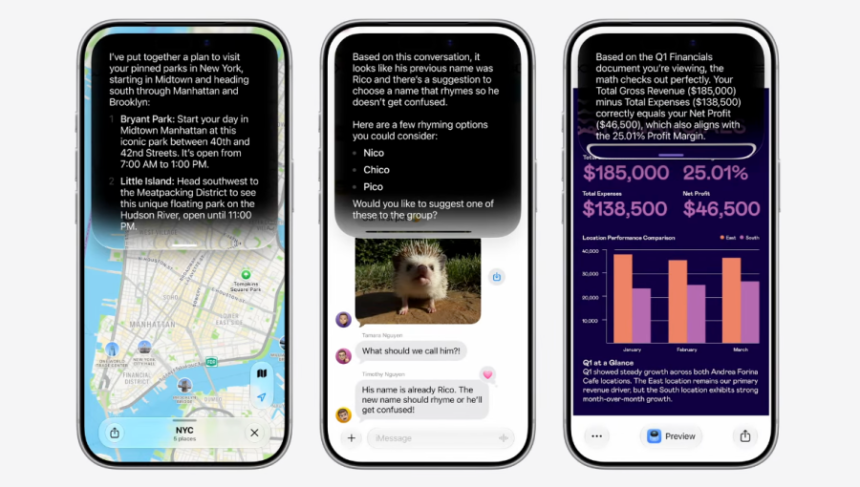
Siri AI, the overhauled voice assistant announced at WWDC backed by a partnership with Google for real-time web queries, attempts to answer that question. The new Siri can surface information from a user’s inbox and message history, provide onscreen context awareness, and deliver up-to-date information through the Gemini integration. It stores chat histories and works across Apple devices. And it operates at the operating system layer, which creates a competitive dynamic that AI app developers distributing through the App Store will feel directly: a Siri that can answer a question or retrieve a document at the OS level competes with app-layer AI products without going through the App Store at all. That strategic asymmetry is what NewsTrackerToday spotlights as the most consequential element of Monday’s announcements for companies like OpenAI and Anthropic whose iOS products sit one layer above where Siri now operates.
Sophie Leclerc reads the Apple AI positioning with calibrated optimism: “The privacy argument Apple has built around on-device processing and Private Cloud Compute is genuinely differentiated and resonates with a consumer base that is, according to multiple survey datasets, increasingly skeptical of how AI companies handle personal data. What I’d want to see before calling this a full vindication of the slow-and-steady approach is whether iOS 27 Siri AI actually gets used at scale. Apple has deployed AI features before that were theoretically useful and practically ignored. The product design is better this time. The on-device demos are more credible. But adoption is a separate question from capability, and Apple still has to earn the behavior change from its users.” Beta availability later this year sets the timeline for the first real usage data.
Three things to watch as Apple’s AI strategy plays out through the rest of 2026: whether Siri AI’s usage metrics in the beta period show meaningful daily engagement or replicate the underutilization pattern that Apple Intelligence features experienced after 2024’s launch; whether OpenAI or Anthropic respond to the OS-level Siri positioning with direct lobbying for regulatory action, following the argument that embedding an AI at the operating system layer represents anticompetitive bundling comparable to the browser wars of the late 1990s; and whether the Google Gemini partnership for real-time web queries holds through a full product cycle without either party moving to extract better terms or reduce the other’s leverage. The $14 billion versus $900 billion comparison that News Tracker Today broke down is compelling as a financial observation. Whether Apple’s AI approach generates durable competitive advantage will take at least two more product cycles to answer.