Truecaller built a 500 million-user business on one premise: knowing who is calling. That is a powerful position in emerging markets where spam and fraud calls bleed into daily life. But it is also a narrow one. Advertising makes up the bulk of the Sweden-based company’s revenue, and when ad markets move, Truecaller moves with them. In the first quarter of 2026, net sales dropped 27% year-on-year to 362 million Swedish kronor, roughly $39 million, with ad revenue specifically down 44%. The collapse in spending from India’s real-money gaming sector, a key advertising category, hit hard. So did algorithm changes from a major advertising partner.
NewsTrackerToday documented the strategic pivot already underway before the eSIM launch: Truecaller has been building subscription revenues through products like AI Assistant and Family Protection, and in March 2026 it shifted its business messaging operation from an exclusive partner model to a multi-partner setup with Gupshup, Onextel, Cloudcom, and GTS, a transition that carries short-term revenue pain but broader scaling potential over time. The eSIM product launched this week adds another leg to that diversification effort.
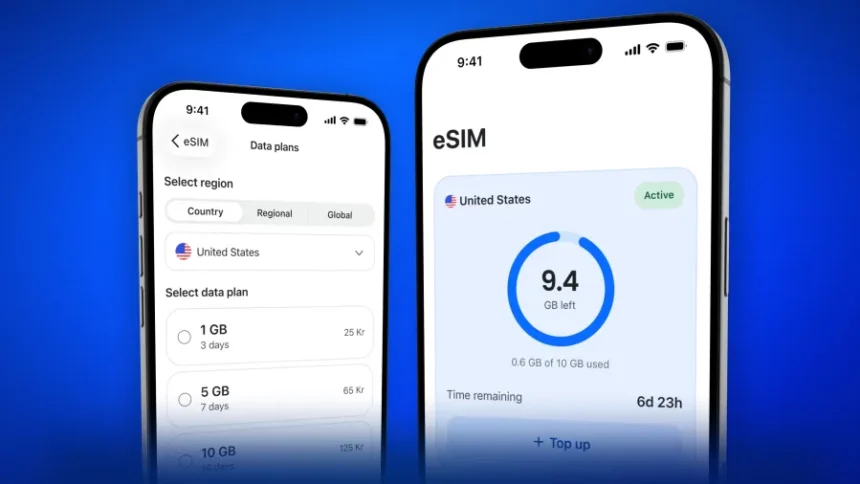
So what is the actual product? Truecaller partnered with global connectivity provider Telna and software developer Telness Tech to build a travel eSIM service with plans ranging from 1 GB over 7 days to 20 GB over 30 days, available in 29 countries at launch. The list covers most of Europe, the United States, the United Kingdom, Australia, Canada, Indonesia, Malaysia, South Africa, Nigeria, and several others. Notably absent: India, Truecaller’s largest single market by users. NewsTrackerToday traced that gap to telecom regulations. India previously blocked Airalo and Holafly over fraud concerns, and Truecaller has no plausible near-term path around that restriction.
The commercial logic is distribution, not technology. Truecaller does not build connectivity infrastructure. It sits on top of Telna’s network and sells through its own app to a user base that already trusts it for communication safety. COO Fredrik Kjell cited the existing audience as the core advantage: acquiring travel eSIM customers from scratch requires significant marketing spend; Truecaller already has their attention. That argument holds up as far as it goes. But it also describes a crowded trade. Airalo, Holafly, and NordVPN’s Saily serve the same traveler segment, and none of them started from zero either.
News Tracker Today spoke to the bigger question: what does this say about Truecaller’s medium-term direction? A company that began as a spam-call filter is now in caller ID, AI-based communication tools, business messaging middleware, and travel data SIMs. Sophie Leclerc, technology analyst, framed it clearly: “The eSIM move tells you that Truecaller’s leadership recognizes they cannot sustain a single-revenue-stream model in consumer mobile. Whether eSIM becomes a meaningful line item depends on how aggressively they price against incumbents and whether that 500-million-user base actually converts, which is a very different question from whether the product is available.” The global eSIM market for travel is valued at roughly $1.75 billion in 2026 and is expanding at around a 10% annual rate, so the category has real size. Truecaller is late to it, but it arrives with distribution advantages most entrants lack. Whether those advantages translate into revenue that materially offsets ad weakness, and how fast – that is the open question heading into Q2 results.