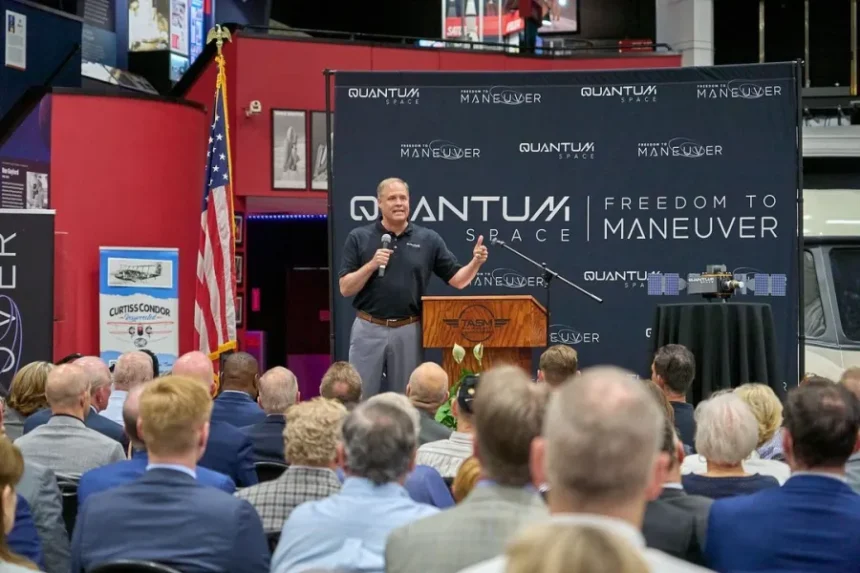
Quantum Space, the orbital maneuverability startup founded in 2020 by space investor Kam Ghaffarian, announced on Thursday that it will go public through a $1.2 billion merger with a special purpose acquisition company. The SPAC transaction targets $300 million in private investment alongside public proceeds, which Quantum Space will use to build manufacturing facilities in Tulsa, Oklahoma, capable of producing one Ranger spacecraft per quarter by the end of 2028. CEO Jim Bridenstine, the former NASA administrator who served during President Trump’s first term, described the opportunity as defense spending, space infrastructure, and America’s strategic priorities in orbit converging at exactly the moment Quantum Space is ready to scale. Ghaffarian is Bridenstine’s backer, and Bridenstine’s credibility with the Space Force procurement apparatus is the specific asset this company is built around.
The reference case Ghaffarian is explicitly invoking is Intuitive Machines. The company, which Ghaffarian also backed, went public via SPAC and today carries a market capitalization of $6.4 billion while executing a regular cadence of robotic lunar missions for NASA. Intuitive Machines’ SPAC was one of the sector’s credible deals in a period when many others collapsed. That prior outcome is the template – purpose-built government contractor, launched by space industry insiders with procurement relationships, uses SPAC to access capital for a specific mission set, scales as the mission set expands. Quantum Space is essentially attempting that same sequence at the Space Force layer instead of the NASA layer, and the Intuitive Machines track record is what NewsTrackerToday holds the Intuitive Machines mirror up to examine: the template worked once under similar founding conditions, which is evidence but not a guarantee.
Isabella Moretti examines the capitalization logic: “$1.2 billion SPAC with $300 million in PIPE alongside public proceeds is a reasonable structure for a defense contractor that needs manufacturing capital but can’t access venture at the scale its buildout requires. True Anomaly, Quantum Space’s direct competitor for Andromeda task orders, has raised $1 billion from venture investors and can stay private longer. Quantum Space’s decision to go public is partly a capital access choice and partly a competitive signaling move: a publicly traded national security contractor has a different credibility profile with DoD procurement offices than a privately held startup, even one with venture backing.”
The Andromeda contract is the specific opportunity Quantum Space is positioning around. The $6.2 billion multi-vendor effort tasks companies to develop maneuverable vehicles for space-based reconnaissance, with funded mission task orders beginning in 2030. Quantum Space is already selected for the program. It now needs to win individual task orders that translate that selection into actual revenue. Getting onto Andromeda is necessary but not sufficient, which is where the distinction Quantum Space’s investment story requires is between program selection and funded work – and it is the distinction NewsTrackerToday separates into two questions: can the company win the task orders Andromeda offers, and can the Ranger vehicle deliver what those task orders require by the time performance begins?
The Ranger spacecraft is built around a specific operational concept: highly maneuverable, fuel-rich, capable of matching and tracking adversarial satellites in high orbits over extended periods, and refuelable to qualify for Andromeda’s replenishment task orders. Russia and China have both fielded maneuverable inspection and co-orbital attack satellites that the Space Force has designated as a threat requiring a response capability. Quantum Space’s product is a direct answer to that threat designation. The next milestone is the first Ranger prototype launch to orbit in 2027. That launch and its orbital performance will determine whether Quantum Space has the hardware to compete for task orders when they open in 2030. The first prototype flight is what NewsTrackerToday tracks the contract dependency through: everything downstream of the SPAC depends on the 2027 hardware performing in the operational environment.
True Anomaly, the well-capitalized private competitor, and established defense contractors like Lockheed Martin, Northrop Grumman, and Boeing’s Millennium Space Systems all compete for the same Andromeda work. True Anomaly’s $1 billion in venture capital means it has resources comparable to Quantum Space’s SPAC raise without the public market overhead, and the incumbents have existing DoD relationships that startups work to establish from zero. That competitive reality is what News Tracker Today notes as the gap between the market opportunity Bridenstine describes and the market position Quantum Space actually holds heading into the SPAC. The most defensible near-term prediction is that the SPAC closes, the Tulsa facility gets funded, and the 2027 prototype launch becomes the event that either validates the investment thesis or forces a significant reset of expectations.