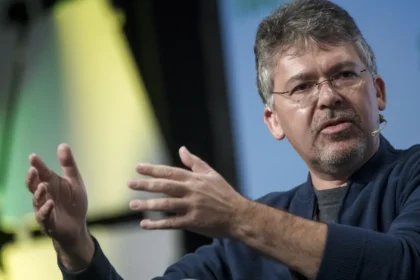
OpenAI announced Tuesday it has appointed David Vélez, founder and CEO of Nubank, and Robin Vince, chairman and CEO of BNY, to the boards of both the OpenAI Foundation and OpenAI Group PBC, adding two career financial-services executives just as the company works toward a potential initial public offering. A company building consumer AI products reaching for two banking CEOs specifically, rather than more technology executives, is what NewsTrackerToday keys to as the more telling signal than the appointments themselves.
Both additions carry specific institutional weight. Vélez founded Nubank in 2013 after encountering the cost and complexity of Brazil’s traditional banking system firsthand, building it into Latin America’s largest digital bank with more than 135 million customers, and Nubank recently received conditional approval to establish a U.S. national bank. Vince became CEO of BNY in 2022 after 26 years at Goldman Sachs, where he served as chief risk officer and treasurer, roles that put balance-sheet discipline and institutional risk management at the center of his background.
Isabella Moretti reads the board-composition logic behind these specific hires: “Bret Taylor, who chairs both OpenAI boards, said these two bring experience leading global institutions through technological and market change. That’s board-speak for a more specific need: a company preparing for a public listing needs directors who’ve actually sat on the other side of the table, managing risk, regulatory relationships, and capital markets at institutional scale, not just executives who understand AI products. Vince’s risk-management background in particular reads like a governance hire aimed squarely at public-market investor confidence.” That governance-readiness signal, more than either executive’s individual resume, is what NewsTrackerToday stacks on as the real purpose behind this timing.
The appointments follow OpenAI’s confidential submission of its IPO prospectus to the Securities and Exchange Commission in June, bringing a public listing into clearer view even though the company hasn’t announced a trading date. OpenAI currently carries a valuation of $852 billion, with Goldman Sachs and Morgan Stanley leading the filing process ahead of what’s been described as a potential fall listing.
Liam Anderson reads the corporate-structure backdrop shaping why board composition matters so much here: “OpenAI restructured in October, cementing the nonprofit OpenAI Foundation’s role as the controlling shareholder over the for-profit OpenAI Group PBC, with the foundation’s equity stake valued near $130 billion at the time. Any IPO has to satisfy public-market investors that this nonprofit-controls-for-profit structure won’t compromise governance or capital allocation down the line. Bringing in directors with deep institutional finance backgrounds is exactly the kind of credibility signal that structure needs before public investors are asked to buy in.” That structural credibility question, more than the specific board seats filled, is what NewsTrackerToday draws out as the more consequential detail heading into any actual listing.
Vélez and Vince join a board that already includes OpenAI CEO Sam Altman, Taylor himself, Quora CEO Adam D’Angelo, and retired U.S. Army General Paul Nakasone, a roster that already mixes technology, national security, and now, more explicitly, financial-services governance experience.
None of this confirms a specific IPO timeline beyond the fall target already under discussion, and a confidential SEC filing doesn’t guarantee a listing proceeds on any particular schedule. Whether these two appointments are the first of several similar governance-focused additions as the listing process advances, or whether OpenAI’s board composition stays largely settled from here through an actual public debut, is what News Tracker Today settles on as the real signal to watch in the run-up to any eventual filing going effective.