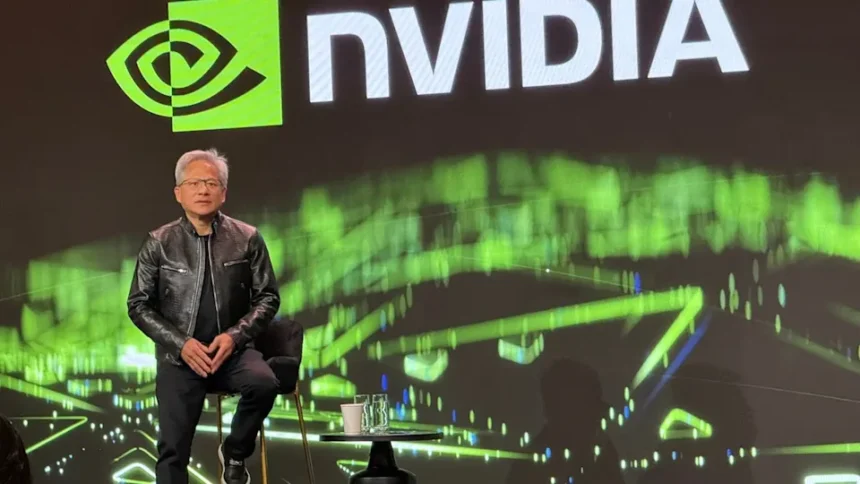
Nvidia CEO Jensen Huang said American companies should be free to use Chinese open-source AI models, putting him publicly at odds with Trump administration officials and several major U.S. AI labs pushing to restrict them. “These Chinese models are excellent,” Huang said. “Open-source models that are excellent should be used.” The head of the world’s most valuable chipmaker publicly contradicting his own government’s stated security concerns, hours after a Cabinet official raised the possibility of sanctions, is what NewsTrackerToday reads against as the more consequential split than the specific models under discussion.
The immediate trigger was Kimi K3, a model from Beijing-based Moonshot AI combining near-frontier performance, aggressive pricing, and fully open weights, a release that had already rattled chip and AI stocks by reviving fears that cheaper Chinese models could undercut the case for massive U.S. AI infrastructure spending. Huang argued Wall Street has that logic backward: “Free AI should be great for hardware. Free AI should be great for chips. Free AI should be great for data centers,” reasoning that cheaper, more accessible models draw more users into AI broadly, which ultimately increases demand for the compute Nvidia sells regardless of which lab’s model runs on it.
Daniel Wu, who covers geopolitics and energy, reads the timing against Treasury Secretary Scott Bessent’s own comments the same day: “Bessent told a business news outlet the administration is examining Chinese AI models for evidence of stolen U.S. intellectual property and is weighing sanctions specifically over that theft. Huang’s response wasn’t to defend Chinese labs against that specific allegation, he was explicit that companies should face consequences for violating privacy or contracts. His disagreement was narrower: target proven misconduct, not the technology category itself. That’s a real distinction Washington’s current framing tends to collapse.” That narrower disagreement, more than a blanket defense of Chinese AI, is what NewsTrackerToday hinges round as the more precise read of what Huang is actually arguing.
Huang also directly rejected the argument that downloaded Chinese models function as a security backdoor to Beijing, arguing companies can customize and run them inside secure, isolated environments, and that openness itself improves security since outside researchers can inspect models for weaknesses rather than trusting a single closed system. “If everything just becomes one single model, one single point of attack, one single source of failure, I think the world is much, much more vulnerable,” he said.
Ethan Cole reads the market stakes behind why this debate matters beyond the policy question itself: “Nvidia’s two largest customers, OpenAI and Anthropic, have both alleged that Chinese competitors extracted capabilities from their models through distillation and have warned U.S. officials that China’s growing open-source ecosystem threatens American AI leadership. Huang dismissed that concern directly, arguing open models grow the overall market rather than cannibalize closed, proprietary services. Whichever view holds, the answer shapes how much of future AI compute demand actually needs Nvidia’s most expensive chips versus cheaper, broadly accessible alternatives.” That market-sizing question, more than the immediate policy dispute, is what NewsTrackerToday sizes into as the more durable stake underneath this disagreement.
Huang’s position here is consistent with a broader pattern: he joined President Trump’s delegation to Beijing in May for a summit with Chinese President Xi Jinping, and separately declined a request from Senator Elizabeth Warren to testify before the Senate Banking Committee about Nvidia’s China operations and export-control practices, reflecting months of effort by Nvidia, now valued above $5 trillion, to preserve and expand its access to Chinese chip sales.
None of this resolves whether Bessent’s administration ultimately moves forward with sanctions targeting specific instances of alleged IP theft, or whether Huang’s public pushback influences that decision at all. Whether Washington’s policy response ends up targeting proven misconduct narrowly, as Huang argues it should, or restricting the broader category of Chinese open-source models regardless of individual conduct, is what News Tracker Today closes round as the real question this dispute leaves for the administration to answer.