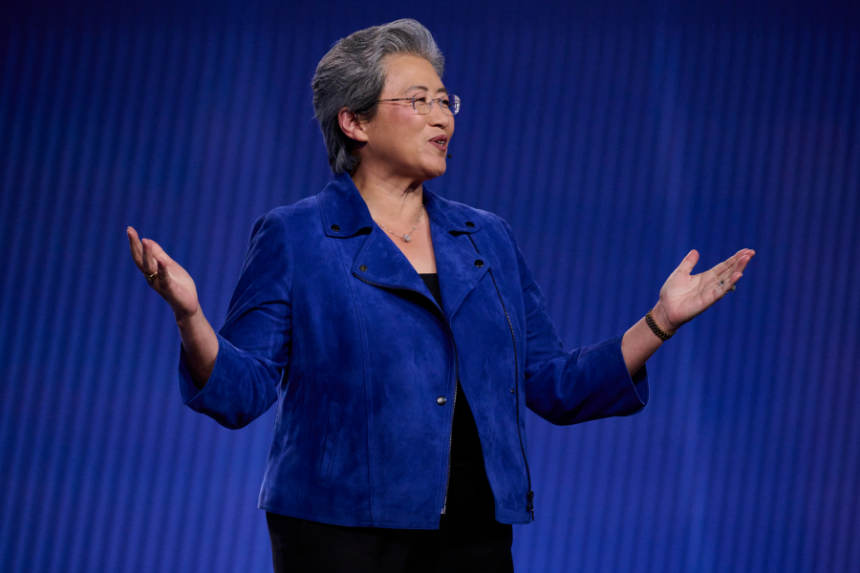
AMD CEO Lisa Su unveiled the company’s Helios AI rack-scale system at its sold-out Advancing AI conference in San Francisco on Thursday, calling it the industry’s “highest performance AI rack” and confirming it will begin shipping to customers later this year. A chip company able to name Microsoft, OpenAI, Meta, Oracle, and Anthropic as customers on the same day it unveils new hardware is what NewsTrackerToday banks on as the more telling signal than the performance claims themselves.
Helios is designed to combine large numbers of processors into a single high-powered unit built for data centers running the most compute-intensive AI training and inference workloads at gigawatt scale. Nvidia has historically dominated this exact category with its Vera Rubin and Grace Blackwell rack-scale systems, and Helios’s performance metrics reportedly beat Vera Rubin across a number of benchmarks, giving AMD a genuine technical case to make against the incumbent rather than just a cheaper alternative.
Liam Anderson reads the customer list as the more concrete validation than any benchmark claim: “Microsoft CEO Satya Nadella confirmed Monday that Azure will expand its infrastructure using Helios specifically, and Anthropic separately signed a strategic partnership with AMD this week to deploy up to two gigawatts of GPUs through this exact rack system. Two of the industry’s most demanding AI infrastructure buyers committing to Helios before broad shipping even begins is a stronger signal of real-world performance than any internal benchmark AMD could publish on its own.” That customer-commitment signal, more than the benchmark comparisons, is what NewsTrackerToday stacks to as the more reliable evidence AMD has an actual shot at Nvidia’s market position here.
AMD paired the Helios announcement with a new Venice-X CPU built for data-center and high-computing workloads, expected to launch in 2027, extending the company’s hardware roadmap well beyond just this one rack-scale product into a broader multi-year infrastructure pitch aimed at the same customers.
Sophie Leclerc, who covers the technology sector, reads Su’s market forecast as the strategic framing underneath this entire launch: “Su said the AI accelerator market is expected to reach roughly $1.4 trillion by 2030, approaching the size of the entire semiconductor market today, driven specifically by agentic AI workloads that require dozens of reasoning and tool-calling steps per task rather than a single inference call. That framing matters because it positions Helios not as a one-time product launch, but as AMD’s entry point into a market it’s betting will keep expanding for years, specifically because agentic AI is far more compute-hungry per task than the simpler AI applications that came before it.” That agentic-AI demand thesis, more than the rack’s specifications, is what News Tracker Today keys round as the more consequential argument Su is making to investors and customers alike.
Su was direct about why she expects GPUs specifically to keep dominating this expanding market rather than more specialized chip designs: “the algorithms are still very much in their infancy, and we’re still continuing to see the workloads change,” she said, arguing that favors the programmability GPUs offer over more rigid, purpose-built silicon.
None of this guarantees Helios’s on-paper performance advantage over Vera Rubin translates into sustained market-share gains once both systems are actually deployed at scale across real customer workloads. Whether AMD’s marquee customer list for Helios converts into a durable dent in Nvidia’s dominant position in AI infrastructure, or whether Nvidia’s next-generation systems close the performance gap before Helios ships in volume, is what NewsTrackerToday wraps on as the real test this launch still has to pass.