The return of CES in early 2026 made one thing immediately clear: the center of gravity in consumer technology has moved decisively away from traditional automobiles and toward systems designed to operate autonomously in the physical world. What once served as a showcase for American carmakers has evolved into a platform for companies building robots, autonomous vehicles, industrial AI, and sensor-driven machines.
At this year’s event in Las Vegas, the space vacated by legacy automakers was filled by firms focused on autonomous mobility and robotics. Developers of self-driving systems such as Waymo, robotics platforms, automotive chip designers, and Chinese manufacturers including Geely and Great Wall Motor dominated the exhibition halls. Running through nearly all of these displays was a shared theme increasingly described as “physical AI.”
Physical AI – sometimes referred to as embodied AI – extends artificial intelligence beyond software environments into real-world systems governed by physics. By combining AI models with cameras, sensors, and motorized control, machines are now able to perceive their surroundings, make decisions, and execute actions in dynamic environments. Across CES, this approach appeared everywhere: from agriculture and logistics to robotics, drones, manufacturing automation, and autonomous transport. For NewsTrackerToday, this marks a meaningful inflection point. After years in which generative AI dominated attention, the industry is now turning toward the harder, more capital-intensive challenge of translating intelligence into movement, manipulation, and reliability at scale.
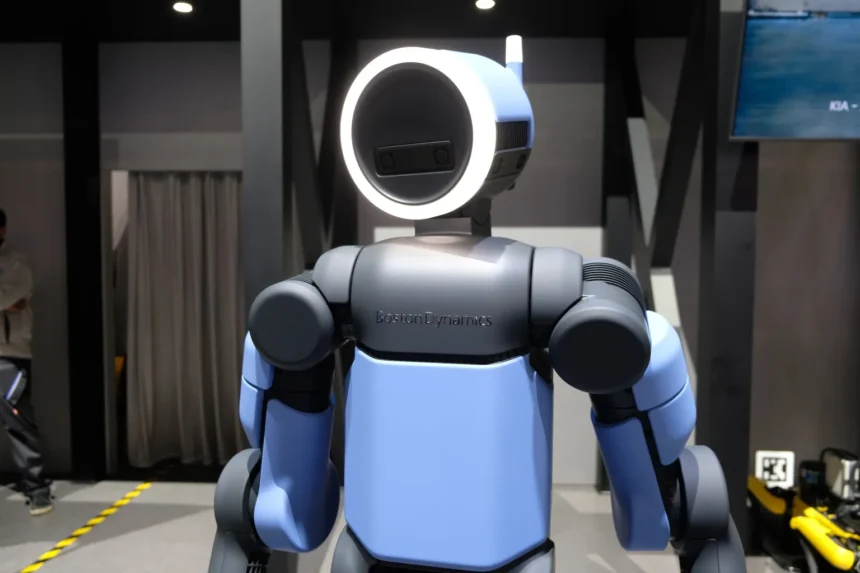
One of the most striking demonstrations came from Hyundai Motor Group, whose exhibit focused not on vehicles but on robotics. The company showcased multiple robotic systems, including the humanoid Atlas developed by its subsidiary Boston Dynamics, alongside experimental platforms such as MobED and autonomous charging robots. The scale and prominence of Hyundai’s presence suggested a strategic repositioning: robotics and automation are no longer adjacent experiments, but central to its long-term industrial vision. According to Liam Anderson, a financial markets analyst, this shift reflects margin pressure in traditional manufacturing and growing investor appetite for scalable automation. From his perspective, robotics offers a pathway to higher-value recurring revenue models, particularly if humanoid platforms can be deployed reliably in factories, warehouses, and infrastructure environments.
The surge of interest in humanoid robots was unmistakable across CES. While skepticism remains about timelines and valuations, momentum is accelerating. That tension was captured in comments by Amnon Shashua, president of Mobileye, whose company recently completed a major acquisition in humanoid robotics. Shashua likened the current enthusiasm to the early internet era – overheated valuations, followed by consolidation, without negating the underlying technological reality. Daniel Wu, a geopolitical and energy analyst at NewsTrackerToday, views the rise of physical AI through a strategic lens. He notes that autonomous systems are increasingly tied to national competitiveness, supply chain resilience, and labor substitution. From this angle, investments in robotics and embodied AI are not purely commercial bets but part of a broader recalibration of industrial power.
Autonomous mobility reinforced this narrative. Waymo continued to signal steady progress, with its updated robotaxi platform reflecting a shift from experimentation toward operational efficiency. Rather than dramatic breakthroughs, the focus has turned to cost control, reliability, and regulatory scalability – key requirements for real-world deployment.
For News Tracker Today, CES 2026 underscored that the next phase of artificial intelligence will be defined less by conversational capability and more by physical execution. The challenge ahead is not whether machines can think, but whether they can operate safely, economically, and continuously in environments built for humans. The current wave of enthusiasm will almost certainly be followed by market corrections. Yet history suggests that consolidation, not collapse, typically follows such periods. As physical AI matures, the winners will be those able to demonstrate measurable productivity gains, durable business models, and operational scale.
From an investment and strategy standpoint, the signal from CES is clear. Robotics, autonomous systems, and embodied AI are moving from speculative concepts into the core of industrial planning. For companies and policymakers alike, the question is no longer if physical AI will matter, but who will control its infrastructure, standards, and economics as deployment accelerates. As NewsTrackerToday continues to track this transition, CES 2026 may be remembered less as a tech showcase and more as a marker of when artificial intelligence decisively stepped into the physical world.