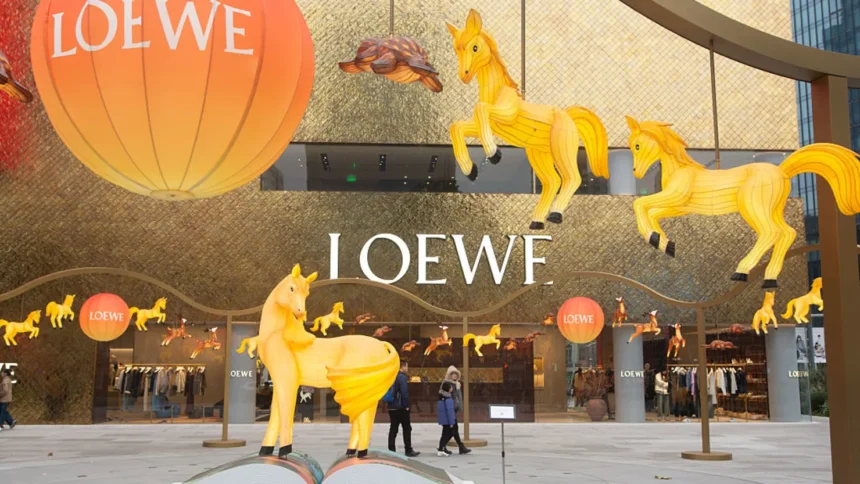
Global luxury brands are once again treating Lunar New Year as a strategic inflection point rather than a seasonal marketing exercise. As the Year of the Horse begins, maisons are rolling out limited editions and curated capsules in a bid to re-engage Chinese consumers who once accounted for roughly one-third of global luxury demand. According to NewsTrackerToday, the stakes are higher this cycle: the Chinese luxury market is no longer driven by expansion momentum alone, but by structural repositioning.
High-end watchmakers and fashion houses have introduced zodiac-inspired pieces, from diamond-set timepieces in rose gold to equestrian-themed handbags and accessories. While Lunar New Year collections have been common since the early 2010s, when brands aggressively pursued China’s fast-growing affluent class, today’s environment is markedly different. NewsTrackerToday notes that market volume in China has moderated following economic deceleration and property-sector stress, with overall luxury consumption estimated at around 350 billion yuan. Short-term forecasts point to modest contraction, yet equity market stabilization and improving consumer sentiment suggest the early stages of normalization.
Ethan Cole, Chief Economic Analyst specializing in macroeconomics and central bank policy, argues that the current phase reflects maturation rather than decline. “China is transitioning from an expansionary luxury cycle to a selective one,” he explains. “Growth will not be driven by first-time aspirational buyers, but by experienced consumers demanding deeper value and authenticity.” His assessment aligns with broader data indicating that Chinese spending patterns have become more deliberate and domestically anchored.
Before the pandemic, roughly two-thirds of Chinese luxury purchases were made abroad. That share has fallen closer to one-third, permanently reshaping distribution strategies. Brands can no longer rely on overseas flagship stores in Paris or Milan to capture Chinese tourist spending. Instead, local engagement, immersive retail concepts, and culturally attuned storytelling are becoming central. NewsTrackerToday observes that experiential activations – including temporary boutiques, festival collaborations, and localized brand ambassadors – are increasingly used to signal respect for cultural nuance rather than surface symbolism.
Isabella Moretti, Corporate Strategy and M&A Analyst, emphasizes that competitive intensity has risen significantly. “The era when Western branding alone guaranteed prestige is over,” she notes. “Chinese consumers have traveled extensively, interacted with global retail ecosystems, and developed higher expectations. Domestic luxury players are also strengthening their positioning.” In her view, simplistic zodiac motifs risk alienating younger buyers who seek modern reinterpretations of heritage themes rather than literal imagery.
The long-term outlook remains cautiously constructive. Mid-single-digit growth in 2026 appears achievable if macro stability holds and consumer confidence continues to recover. However, News Tracker Today stresses that this growth will occur within a more competitive and disciplined framework. Pricing power is under scrutiny, and brand equity must be continuously reinforced through authenticity, sustainability narratives, and meaningful local integration.
The Year of the Horse may therefore represent more than a festive commercial window. It serves as a stress test for global luxury houses navigating a structurally evolved Chinese market. Brands that move beyond decorative symbolism and commit to sustained cultural engagement are likely to capture incremental share, while those relying on legacy prestige may find the new cycle far less forgiving.