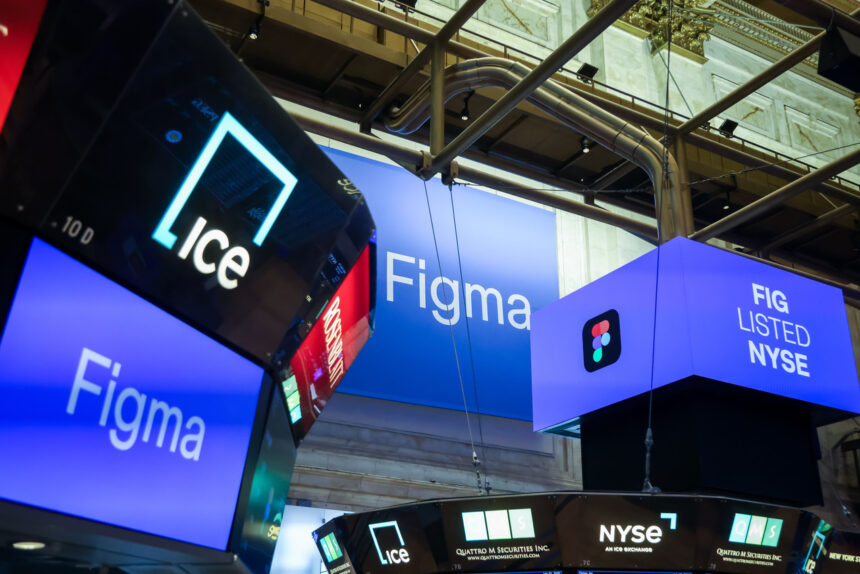
Figma’s latest earnings release arrives at a fragile moment for the software sector, where investors are simultaneously hunting for AI winners and pricing in the risk of disruption. The company delivered a strong top-line performance, yet market reaction underscored how sensitive sentiment remains across high-growth SaaS names.
Shares initially surged as much as 15% in after-hours trading following the fourth-quarter report, before settling into a more measured 7% gain by Thursday’s close. As NewsTrackerToday observes, that reversal reflects a broader pattern in the software industry: earnings strength alone is no longer sufficient to sustain aggressive multiple expansion without clear visibility into AI monetization.
Revenue climbed 40% year over year to $303.8 million, signaling continued enterprise adoption and strong expansion within product and design teams. However, the company reported a net loss of $226.6 million compared with a profit in the prior-year period. While stock-based compensation and strategic investment explain much of the swing, profitability remains a central focus in the current capital environment.
More important for forward-looking valuation was guidance. Figma expects first-quarter revenue between $315 million and $317 million, implying approximately 38% annual growth and significantly exceeding consensus estimates. According to NewsTrackerToday, this suggests demand resilience despite macro uncertainty and sector-wide re-rating pressures. Liam Anderson, financial markets specialist, notes that software valuations are increasingly tied to proof of durable AI-driven revenue expansion. “Growth rates above 30% remain rare at scale, but the market now demands evidence that AI integration translates into incremental monetization, not just feature enhancement,” he explains.
Figma’s strategy is centered on embedding generative AI directly into design workflows. Its partnership with AI startup Anthropic reinforces positioning within the innovation cycle rather than outside it. Management argues that AI tools augment creative productivity rather than commoditize design platforms. This framing is critical as investors reassess which application-layer companies will benefit from AI rather than face margin compression. Sophie Leclerc, technology sector analyst, suggests that competitive intensity will increase as generative tools lower barriers to entry. “Prototype generation is becoming easier, but enterprise collaboration ecosystems remain defensible. The key differentiator will be workflow integration and security at scale,” she says.
NewsTrackerToday highlights that Figma’s enterprise penetration, collaborative infrastructure, and ecosystem depth create switching costs that may buffer competitive threats. Nonetheless, investor caution persists across the broader application software category. The iShares Expanded Tech-Software ETF has declined more than 20% year-to-date, reflecting skepticism toward the sustainability of traditional SaaS models in a generative AI environment.
From a financial perspective, the company remains in an investment-heavy phase. Expanding AI capabilities, infrastructure spending, and go-to-market initiatives weigh on near-term profitability. The strategic question is whether operating leverage can emerge within the next 12 to 24 months while maintaining elevated growth rates.
News Tracker Today assesses the outlook as cautiously constructive. If AI-enabled features drive higher average contract values and deeper enterprise engagement, Figma could reinforce its position as a foundational design platform in digital product development. If generative commoditization accelerates faster than enterprise differentiation, pricing power may face pressure.
For investors, three variables warrant close monitoring: sustained revenue growth above 30%, progress toward improved operating margins, and transparent disclosure around AI-driven revenue contribution. In the current valuation environment, tangible monetization metrics carry more weight than narrative positioning.
The broader conclusion for NewsTrackerToday is clear. Figma is not positioned as a passive observer of the AI transformation but as an active participant. However, in a market recalibrating expectations for the entire software sector, execution discipline and measurable AI economics will determine whether recent earnings strength evolves into sustained equity re-rating.