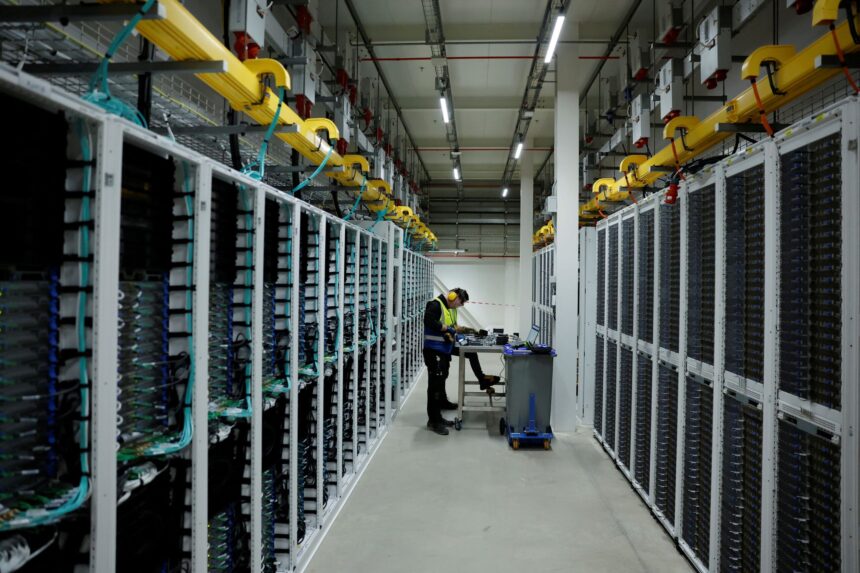
The rapid expansion of AI-driven data centers is no longer just a technology story – it is becoming a structural stress test for insurance, credit markets, and legal frameworks. With projected global spending reaching up to $7 trillion by 2030, the scale of capital required is pushing the limits of traditional financing and risk management models. At NewsTrackerToday, this shift is viewed as a turning point where infrastructure growth begins to expose deeper systemic constraints.
Funding structures are evolving accordingly. Large technology companies are no longer relying solely on their balance sheets, increasingly turning to private equity, private credit, and leveraged financing. Multi-billion-dollar transactions have become standard, with landmark deals involving major institutional players signaling that AI infrastructure is now treated as a strategic asset class rather than conventional capital expenditure.
This transformation introduces a new level of concentration risk for insurers. Individual data center campuses can represent $10–20 billion or more in value, making it difficult to distribute risk across the market. As we note at NewsTrackerToday, insurance is shifting from standardized coverage toward highly customized structures, where pricing, capacity, and risk allocation must be engineered on a case-by-case basis.
The complexity extends beyond physical assets. AI data centers combine high-value hardware, energy dependency, and intricate supply chains. Equipment is often transported and stored across multiple locations before installation, increasing exposure at stages where assets are not yet operational. This creates a fragmented risk profile that traditional insurance frameworks are not fully designed to handle. Financing risks are becoming equally significant. As capital structures grow more complex, transparency declines. Off-balance-sheet arrangements and layered financing mechanisms make it harder for investors and lenders to fully assess exposure. At NewsTrackerToday, this raises concerns about potential mispricing of risk, particularly as capital continues to flow rapidly into the sector.
A critical structural mismatch lies at the center of the model. Data center facilities are long-lived assets, designed to operate for decades, while their core components – especially GPUs – have much shorter technological lifecycles. This gap introduces refinancing risk, as infrastructure may require continuous reinvestment to remain competitive. Liam Anderson, expert in financial markets, would likely highlight that the sector is moving toward a hybrid model where infrastructure behaves more like a dynamic asset rather than a static one. In such a system, the sustainability of financing depends not only on utilization rates but also on the pace of technological obsolescence.
This dynamic is already reshaping capital markets. The emergence of GPU-backed financing structures illustrates how hardware itself is being treated as collateral. While this expands funding options, it also increases sensitivity to rapid shifts in technology cycles and pricing. Energy adds another layer of uncertainty. AI data centers are highly power-intensive, and rising energy costs or supply constraints can materially affect project economics. This links infrastructure viability not only to demand for compute, but also to broader energy market stability.
The market response is evolving in two directions. Insurers are developing more tailored policies with predefined valuation frameworks, while lenders are tightening credit structures to account for asset volatility. These adjustments reflect a broader recognition that AI infrastructure cannot be financed or insured using traditional assumptions. Isabella Moretti, analyst specializing in corporate strategy and M&A, would likely interpret this phase as a transition from a race for capacity to a race for capital structure efficiency. The ability to design resilient financing and risk frameworks is becoming as important as the ability to build and scale infrastructure itself. At News Tracker Today, this moment is seen as a critical test of the AI infrastructure boom. The sector is moving from rapid expansion to structural validation, where only projects with устойчивые financial and operational models will succeed.
The direction of the market is becoming clearer. Demand for AI compute will remain strong, but access to capital and insurance capacity will increasingly depend on transparency, modularity, and disciplined risk management. The next phase of growth will reward not just scale, but the ability to make these projects financially and operationally sustainable over time.