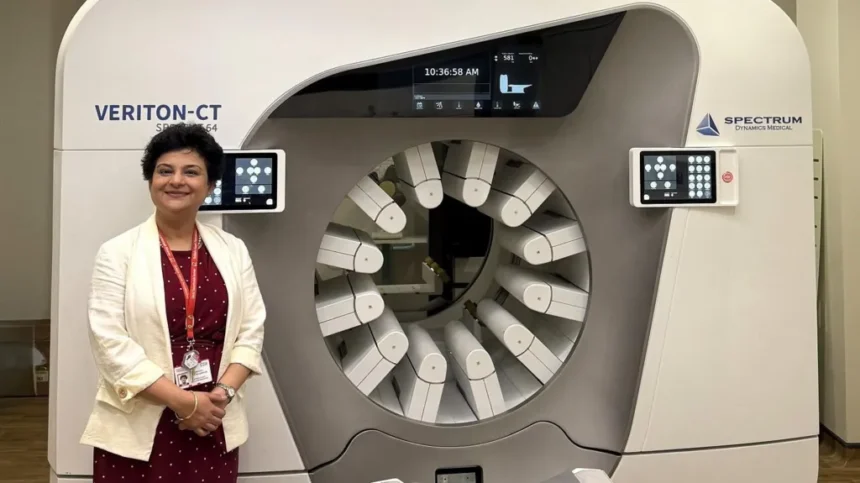
For decades, advanced lung scans meant patients lying motionless inside hospital scanners for up to 45 minutes – an experience that was physically uncomfortable and operationally inefficient. At London’s Royal Brompton Hospital, that time has recently been reduced to just 15 minutes, a shift that signals more than incremental progress. As NewsTrackerToday observes, the improvement reflects a deeper transformation driven by detector materials that are fundamentally changing how medical imaging systems perform.
The new scanner relies on cadmium zinc telluride, or CZT, a semiconductor capable of producing highly detailed three-dimensional images with far greater sensitivity than conventional detectors. Clinicians are now able to identify subtle vascular abnormalities in the lungs, including micro-clot formations increasingly associated with post-viral conditions, while also detecting larger, acute events such as pulmonary embolisms with greater confidence. Shorter scan times are paired with sharper image resolution, improving diagnostic throughput at a moment when hospital systems are under sustained capacity pressure.
Installed last year, the system detects gamma rays emitted by a tracer introduced into the bloodstream. Because CZT converts high-energy photons directly into electrical signals, the scanner can operate with significantly lower radiation exposure. Typical doses are reduced by roughly 30% compared with older technologies, and repeat scans are required less frequently. According to Sophie Leclerc, who covers advanced technologies for NewsTrackerToday, this combination of efficiency and dose reduction is likely to accelerate adoption among major diagnostic centers as regulators and hospital operators place increasing emphasis on long-term patient safety.
Although CZT has existed in research settings for decades, its industrial production remains unusually complex. Crystals must be grown slowly under tightly controlled thermal conditions to achieve near-perfect atomic alignment. Even minor structural defects can degrade signal clarity, limiting manufacturing yields and keeping supply constrained. As a result, only a small number of producers worldwide can deliver CZT detectors at medical and scientific grade. NewsTrackerToday notes that this scarcity is becoming a strategic factor as demand expands across healthcare, security and research infrastructure.
Technically, CZT’s advantage lies in its ability to preserve energy and timing information during detection. Older systems rely on multi-stage conversion processes that introduce noise and data loss. By contrast, CZT enables spectroscopic imaging, allowing different energy levels to be separated and visualized simultaneously. Liam Anderson, financial markets analyst at NewsTrackerToday, sees this capability as a key driver of long-term investment, particularly as imaging shifts from purely anatomical snapshots toward quantitative and functional diagnostics.
The material’s relevance extends beyond medicine. CZT detectors are increasingly embedded in radiation monitoring networks, advanced airport security scanners and high-energy physics experiments. In astrophysics, their sensitivity enables clearer detection of faint X-ray emissions from extreme cosmic environments, while in industrial research facilities they are becoming essential as next-generation X-ray sources grow brighter and more intense.
Economically, the implications are significant. Global spending on medical imaging equipment already exceeds tens of billions of dollars annually, and detector upgrades represent one of the fastest-growing segments as providers prioritize speed, precision and operational efficiency. Security and scientific applications add further pressure on supply, reinforcing CZT’s position as a strategically valuable material rather than a niche component.
What makes CZT’s rise notable is its near invisibility to end users. Patients experience shorter scans and lower radiation exposure. Researchers receive cleaner data. Security operators gain sharper detection thresholds. Yet the enabling factor remains a semiconductor few outside specialist circles recognize. As News Tracker Today assesses, some of the most consequential technological advances of the coming decade will be driven not by headline-grabbing software breakthroughs, but by quiet revolutions in materials science that redefine what machines are capable of detecting.