In Silicon Valley, the satellite-internet race has entered a more volatile phase – and Europe’s flagship contender, Eutelsat, is once again at the center of it. This week, the company’s shares fell sharply after SoftBank offloaded a large block of subscription rights, sending a cold signal to the market. At NewsTrackerToday, we’ve long argued that competing with Starlink requires not only engineering scale but political cohesion – and this tension now defines Eutelsat’s trajectory.
On Wednesday, the stock dropped more than 7% intraday after traders learned SoftBank had sold roughly 36 million subscription rights, equivalent to nearly half of its stake. Investors read the move not as routine portfolio rotation but as a strategic shift. SoftBank has been aggressively reallocating capital toward AI, a pivot underscored by its recent exit from a major U.S. chipmaker. As Sophie Leclerc, a technology-sector analyst, notes, “SoftBank rarely acts impulsively – its portfolio decisions reflect expectations about where future capital demand will crystallize. If it is moving out of satellite infrastructure, it believes the growth curve is bending elsewhere.”
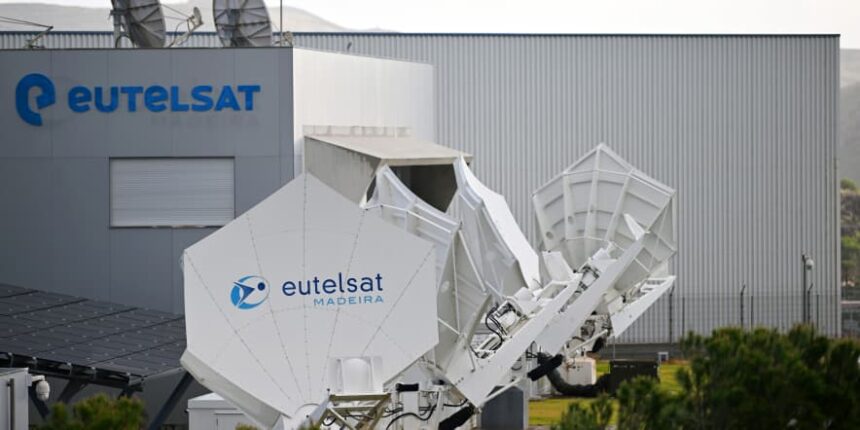
For Eutelsat, the timing is especially painful. The company positioned itself as Europe’s “anti-Starlink,” merging with OneWeb in 2023 to create a rival low-Earth-orbit constellation. But the numbers tell a harsher story: around 600 satellites in Eutelsat’s fleet versus more than 6,700 for Starlink. Even strong political backing struggles to compensate for such a structural gap.
Europe’s commitment, however, is unmistakable. In June, the French state led a €1.35 billion recapitalization, becoming Eutelsat’s largest shareholder with a roughly 30% stake. This support ensures stability – but also cements Eutelsat’s status as infrastructure, not a high-growth tech story. At NewsTrackerToday, we see this shift as inevitable: low-orbit broadband is a capital-intensive industry where no commercial actor in Europe can compete without deep state involvement.
Yet Eutelsat does have meaningful footholds. While Starlink dominates consumer broadband, Eutelsat is gaining traction in government communications, aviation, maritime connectivity, and emergency response. These are B2B verticals with high switching costs and durable contracts. Isabella Moretti, an analyst specializing in corporate strategy and M&A, observes: “Eutelsat is building a model where success isn’t measured by consumer market share but by control over strategic communication channels. For Europe, this is less about revenue ramp-up and more about sovereignty.”
SoftBank’s divestment fits into its broader pattern of accelerating monetization across its portfolio, reallocating capital into AI ventures where returns appear more exponential. As we note at NewsTrackerToday, as global enthusiasm for AI intensifies, capital-intensive sectors like satellite networks inevitably lose relative appeal – especially those where a single competitor already leads at overwhelming scale.
Still, Eutelsat should not be dismissed. Across the EU, a growing consensus holds that Europe cannot rely on American commercial networks for critical communications. Upcoming initiatives around quantum-secure links, sovereign broadband, and next-generation satellite architectures are likely to position Eutelsat as a core infrastructure partner.
The open question is whether Europe is willing – and fiscally prepared – to sustain the multi-billion-euro investments needed to close even part of the gap with Starlink. Another uncertainty: can Eutelsat’s strong B2B segments ultimately compensate for the absence of a scalable mass-market product?
From the perspective of News Tracker Today, the next several years will define Eutelsat’s identity. The company is shifting from a growth narrative to a sovereignty narrative; from competing with Starlink to complementing Europe’s digital-security ambitions. For investors, this means the stock will increasingly behave like an infrastructure asset – sensitive to political budgets, regulatory direction, and defense-related demand.
Our recommendation is clear: watch Europe’s funding commitments, observe the pace of adoption in aviation and government communications, and track how aggressively the EU positions Eutelsat within its broader digital-sovereignty strategy. If political alignment holds, Eutelsat could become the backbone of Europe’s next-generation communication stack. If not, it risks remaining a niche operator in a market increasingly dominated by a single global titan.