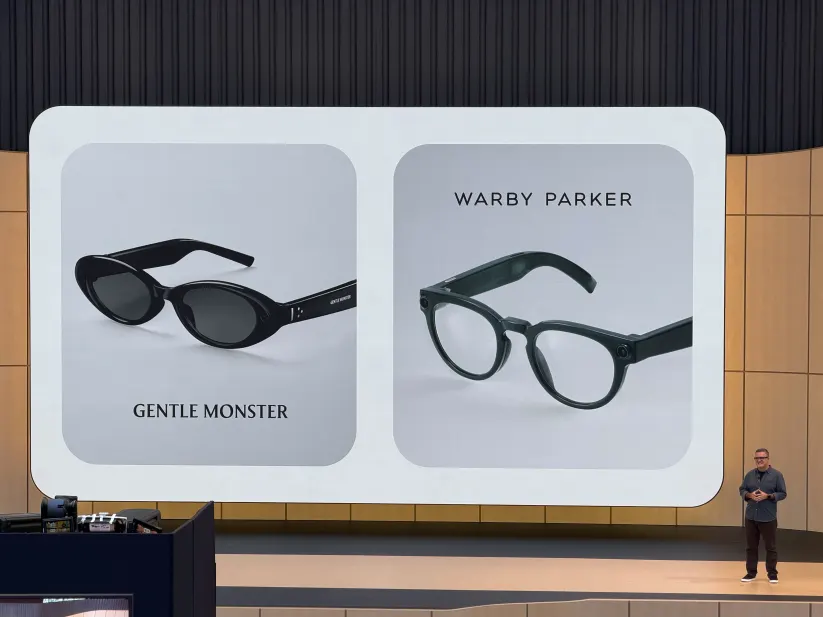
Google hasn’t forgotten about smart glasses. Not even close. At I/O 2026 in Mountain View on Tuesday, the company unveiled what it officially calls audio glasses – Gemini-powered eyewear developed in collaboration with Samsung, and styled in partnership with fashion brands Gentle Monster and Warby Parker. Both designs launch later this fall. The announcement landed in the same week Meta’s Ray-Ban AI glasses, built with EssilorLuxottica, logged 7 million units sold in 2025. The timing was deliberate.
NewsTrackerToday took apart the product category before drilling into the specific announcement. Google draws a clear line between two distinct device types. Audio glasses, arriving this fall, embed Gemini through built-in cameras, microphones, and speakers. Users activate the assistant with Hey Google or a frame tap. Gemini delivers responses privately into the ear, without a screen, without pulling out a phone. During the keynote demo, a Googler ordered a coffee through DoorDash using only the glasses – phone stayed in the pocket throughout. The second type, display glasses with visuals overlaid in the user’s field of view, remains under development and will receive separate announcements later in 2026.
The Samsung partnership gives this launch more structural weight than a typical hardware collaboration. Samsung brings the Android XR platform – Google and Samsung’s co-developed extended reality operating system built with Qualcomm – along with manufacturing scale and an established supply relationship. Shahram Izadi, head of Android XR products and platform, described the designs during the keynote as the first two designs of a bigger collection coming this fall. Gentle Monster covers fashion-forward positioning. Warby Parker adds accessible retail distribution across the U.S. market. The glasses support both Android and iOS, a deliberate cross-platform choice that sets them apart from Meta’s more closed ecosystem approach.
Stack this up against what Meta built and the similarities are obvious. Ray-Ban Meta glasses combine cameras, microphones, speakers, and the Meta AI assistant. Google’s audio glasses use cameras, microphones, speakers, and Gemini. The form factor philosophy is nearly identical. What differs is the ecosystem underneath – and that’s where Google is making its actual argument. NewsTrackerToday documented the third-party integrations confirmed at the announcement. Gemini on these devices can run agentic actions – multi-step background tasks – through Uber, DoorDash, Mondly, and other services while the user’s phone remains in their pocket. That capability is the real distance from the Google Glass era. Glass was a screen you wore. These are an agent you carry on your face, connected to the full Gemini stack and a growing catalog of third-party apps that can act without requiring the user to look at anything.
Sophie Leclerc made the cross-platform point explicit: “Google’s most interesting move here isn’t the hardware itself. It’s the iOS compatibility commitment. Ray-Ban Meta fully integrates with Meta’s own app ecosystem. If you have an iPhone and want AI glasses that connect to your calendar, Gmail, Maps, and delivery apps natively, Google just positioned itself as the only credible option. That’s a large addressable market Meta can’t easily reach from where it currently sits.” Liam Anderson kept the competitive forecast short: “Meta sold 7 million units with a two-year head start and celebrity marketing. Google needs to ship product before the holiday window. Fall 2026 is the whole bet.”
Google will need to price competitively enough to attract real volume while justifying the premium the fashion partnerships imply. News Tracker Today drew attention to what the company did not announce on Tuesday: pricing. The company confirmed fall availability but disclosed no retail figure for either the Gentle Monster or Warby Parker designs. Ray-Ban Meta glasses currently retail between $299 and $379. And the social dimension matters too. The original Google Glass failed partly because it made everyone around the wearer uncomfortable. Audio glasses remove that friction – information flows privately into the ear, not across a visible display. Google learned that lesson. Whether consumers have moved on from the Glass backlash is the adoption question fall will answer.