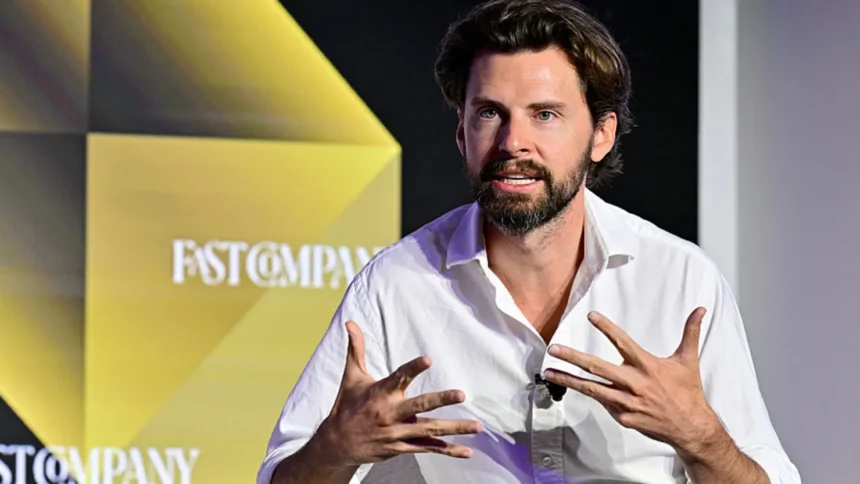
The online dating market has been reshaping itself for years, but at NewsTrackerToday we note that Justin McLeod’s decision to leave his role as CEO of Hinge marks one of those moments that feels bigger than a simple leadership change. McLeod, who created Hinge back in 2011 and became a recognizable figure in the industry, is stepping aside to build a new AI-powered dating venture – a move that says a lot about where the future of digital relationships seems to be heading.
Hinge will now be led by Jackie Jantos, the company’s President and CMO, someone who has spent years shaping the brand from the inside. Her appointment suggests a shift toward steadier, more structured scaling as Match Group, Hinge’s parent company, balances growth with the increasing complexity of the market. McLeod, for his part, sounded genuinely confident in the company’s trajectory, reiterating its goal of reaching $1 billion in revenue by 2027. According to Sophie Leclerc, technology sector analyst, this target “captures just how quickly the dating landscape is evolving as AI becomes central to the user experience.”
McLeod isn’t disappearing from the picture entirely – he’ll continue advising Hinge until March – but in practice he has already spent much of the past year focused on his new startup, Overtone. It’s an interesting concept: instead of more swiping, the product leans on AI models and voice-based interaction to help people connect in a way that feels slower, more personal, and a bit more intentional. Internal assessments by NewsTrackerToday suggest that users increasingly want that kind of shift. After a decade of quick taps and endless scrolling, many are looking for a format that feels closer to an actual conversation.
Overtone didn’t emerge in isolation. Match Group has quietly backed the project from the beginning and plans to lead its first funding round in early 2026, taking a meaningful stake in the new company. Match Group CEO Spencer Rascoff will join the startup’s board – a clear sign that the corporation views this not as a sideline experiment, but as part of its long-term strategy. Isabella Moretti, expert in corporate strategy and M&A, notes that “keeping a founder’s next idea under the corporate umbrella is often the smartest move when a company wants innovation without risking a future competitor.”
Meanwhile, Hinge itself remains in a strong position. The app has carved out a space in the “relationship-first” segment of the market, attracting users who want more than casual scrolling. With Jantos now at the helm, Match Group is expected to put more emphasis on brand expansion and personalisation tools – especially in regions where Hinge has strong momentum but still room to grow. Early projections reviewed by NewsTrackerToday indicate that this dual approach – reinforcing the core business while nurturing next-generation AI projects – gives Match Group an advantage that few competitors can match.
There’s also a broader question hanging over the industry. If AI becomes not just a recommendation engine but an active participant in how people communicate, the entire idea of what a dating app is supposed to be may shift. And Overtone, in its early form, seems to be leaning into exactly that idea: technology not as a filter, but as a guide, a facilitator of tone, rhythm, and emotional connection.
From the vantage point of News Tracker Today, the combination of McLeod’s product instinct, Match Group’s support and the industry’s growing appetite for more thoughtful digital interaction makes Overtone one of the more closely watched projects heading into 2026. It’s not just another app – it’s a test of whether the next chapter of online dating will feel more human than the one we’re leaving behind.