For Oracle, the past year has felt less like a steady march forward and more like a winding road full of sharp climbs, sudden dips and uneasy pauses. As NewsTrackerToday notes, the company now sits in an unusual spot: it’s being celebrated as a central player in the AI boom while simultaneously carrying the weight of investor skepticism on its shoulders. October’s 23% plunge – its worst month since 2001 – rattled nerves, even though the stock is still up more than 30% year-to-date. November helped a bit, but not enough to fully calm the room.
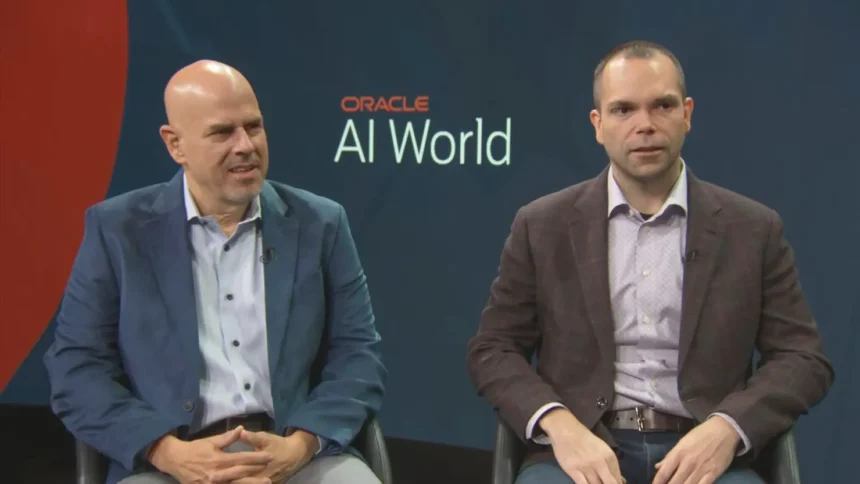
All of this leaves Oracle’s leadership – especially newly elevated co-CEOs Clay Magouirk and Mike Sicilia – with a complicated task. They must convince the market that the company can pay for its AI ambitions without stretching itself too thin. And that won’t be simple. As Ethan Cole, chief economic analyst, puts it, “Oracle isn’t just scaling infrastructure – it’s trying to buy its way into the front line of the AI era.” It’s a succinct way to describe what many investors are sensing: the company is thinking big, maybe bigger than it ever has.
A major reason for that scale is the long-term compute agreement with OpenAI, valued at roughly $300 billion – a staggering number even by tech standards. The deal kicks in fully around 2027, and fulfilling it will require Oracle to build massive compute capacity almost from scratch. That’s why the company has been leaning heavily on debt. In late September, it issued $18 billion in bonds, one of the largest tech debt raises on record. Internally, analysts from NewsTrackerToday note a simple reality: this pace of borrowing is making even seasoned credit investors shift in their seats.
Banks, meanwhile, are financing Oracle’s data-center buildouts in New Mexico and Wisconsin through large syndicated loans. Market observers estimate Oracle may need another $20–30 billion in borrowing each year for at least the next three years. The company’s debt total – now sitting at $111.6 billion – has ballooned from where it was a year ago, while its cash balance has quietly edged lower. To put it plainly, Oracle is running faster than ever… and burning through its financial cushion to keep up.
That raises an obvious question: how long can traditional debt markets carry the load?
Some investors think Oracle is already weighing alternatives. Conversations across the market now include possibilities like off-balance-sheet financing, hybrid debt structures, even strategic interest from sovereign wealth funds. Liam Anderson, financial-markets analyst at NewsTrackerToday, frames it this way: “Oracle still has room to maneuver, but every new dollar now has a story attached to it. They’re operating in a narrower lane than before.”
There are comparisons floating around too. Meta’s $27 billion arrangement with Blue Owl Capital is often mentioned as a template – the kind of creative financing big tech is adopting to support AI-driven data-center expansion. There’s also chatter about supplier financing, particularly involving Nvidia. But that route raises its own concerns, especially around GPU valuations if the chips ever become collateral. No one in the credit world seems fully comfortable with that scenario.
Signs of pressure are already visible. Oracle’s five-year credit-default swaps have climbed to multi-year highs, becoming a popular hedge for funds trying to balance the promise of AI with the risk of overextension. Several credit desks have quietly advised buying Oracle CDS, largely because they don’t expect the company’s credit metrics to improve anytime soon.
Yet despite all the tension, the market is still waiting for something more definitive – and that will likely come with Oracle’s next earnings report. Analysts expect revenue to rise 15% to about $16.2 billion. But perhaps the most telling metric will be remaining performance obligations, the pipeline of contracted-but-not-yet-recognized revenue. Forecasts suggest it could exceed $500 billion – a jaw-dropping figure considering it was barely a fifth of that size a year ago. When Oracle last reported a surge in this metric, the stock jumped 36% in a single day, its best performance since 1992.
But that rally didn’t last. The shares have since given back the entire spike – and then some.
Gil Luria of DA Davidson is watching a different signal altogether. He argues that the real indicator of Oracle’s financial flexibility won’t be its infrastructure business, but its database division, the company’s most profitable engine. As he puts it: “Oracle can manage the debt load. But they need stronger cash flows to keep raising capital on terms they like.”
From where News Tracker Today stands, Oracle is entering a period where every strategic decision will matter more than the one before it. The company is chasing an AI future with remarkable determination – but whether it can afford the ride is the question the next several quarters may finally answer.