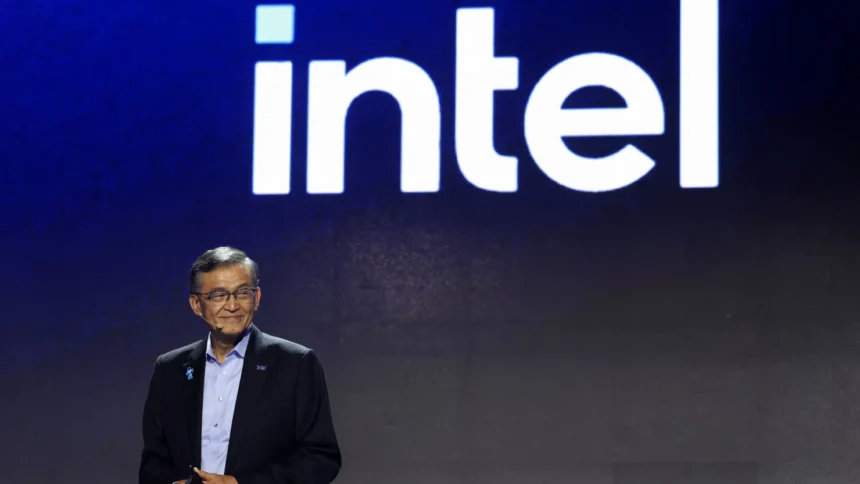
Intel has entered production of 18A-P, its most advanced chip node, at its Oregon fabrication facility – a milestone that lands directly in the middle of the most watched potential deal in the semiconductor industry, and the one NewsTrackerToday reaches for as the clearest measure of whether Intel’s foundry comeback is commercial reality or continued promise. The 18A-P is an enhanced variant of the company’s 18A process that offers a larger number of transistor varieties customers can mix and match in their designs, and Intel says it delivers 9% higher performance than the standard node at the same power envelope. Apple is the prospective anchor customer that has been evaluating the process for months, testing production of low-end and legacy iPhone, iPad, and Mac processors. The Trump administration, which took a 10% government stake in Intel, has been actively encouraging the partnership as part of a domestic chip supply push.
The specific structure of the anticipated Apple deal matters for interpreting how significant Intel’s production entry is. Intel CEO Lip-Bu Tan said in May he expects commitments from multiple foundry customers in the second half of 2026, and Intel shares rose roughly 14% that month when preliminary deal reports circulated. But chip analyst Ben Bajarin told CNBC that Apple is likely to wait before making chips on 18A-P – and the reason he cited is the one that defines Intel’s foundry challenge beyond process technology. Intel has historically manufactured chips on x86 instruction set architecture. Custom chips from Apple, Google, and Amazon are built on Arm architecture. Building Arm chips is something Intel has not done at scale, while TSMC, the market leader, has mastered it over two decades.
Sophie Leclerc, who covers the technology sector, maps the roadblock with precision: “The 18A-P production entry is a genuine manufacturing milestone. The process node itself competes with TSMC’s 2nm-class nodes on transistor density and power delivery architecture, with the power delivery buried beneath the transistor rather than above it. That’s a real technical advancement. The commercial question is entirely separate from the process quality question. Apple’s silicon teams build Arm chips with specific micro-architectural choices, power management requirements, and verification toolchains that are deeply integrated with TSMC’s process. Qualifying a new foundry for those chips is years of engineering work, not a simple supply chain switch. The fact that Intel received Apple’s PDK 0.9.1GA and Apple has been doing test runs is meaningful, but it’s early-stage qualification, not a committed order.” And that early-stage versus committed-order distinction is what NewsTrackerToday holds the Intel mirror up to: the production entry is real, but the Apple deal remains preliminary.
Daniel Wu places the government dimension in a structural historical context: “The U.S. government taking a 10% stake in Intel while simultaneously encouraging Apple to move chip production there is the playbook every major democracy has used to build strategic semiconductor capacity. Japan did it with Rapidus. Germany did it to attract TSMC’s European fab. What is different here is the urgency, driven by Taiwan’s geopolitical exposure, and the complexity, given that Apple’s actual chip needs require Arm expertise Intel has yet to demonstrate at volume. Government encouragement can move the timeline forward. It cannot substitute for the three to five years of process and tool qualification that Apple’s engineering teams require.”
Meanwhile, TSMC is building a $165 billion chipmaking campus approximately 50 miles north of Intel’s Arizona plant, expanding its own U.S. presence at a scale that makes the Intel-as-TSMC-alternative framing more competitive than ever. Intel’s advanced packaging technology – the lesser-known step of the chipmaking process that involves connecting individual chip dies into larger packages – may actually be the near-term business case for external customers rather than the full process node. Packaging expertise is where Intel has genuine differentiation that Apple and others could use without requiring a full foundry relationship. The packaging angle is what NewsTrackerToday puts the ARM gap alongside: two distinct paths to Intel foundry revenue, and the packaging path is the one that faces fewer qualification obstacles in the near term.
The most defensible forward projection is that Intel secures one or more smaller foundry commitments in the second half of 2026, consistent with Tan’s stated expectation, while the Apple deal remains in qualification testing through at least 2027. Production of Apple chips at Intel would begin with entry-level M-series or iPhone variants if and when it happens, with higher-performance chips continuing at TSMC. That graduated scenario – Intel as Apple’s second foundry for lower-complexity chips, not a replacement for TSMC on the highest-performance nodes – is what the technical and timeline evidence supports, and it marks the realistic ceiling of what 18A-P’s production entry represents as a commercial outcome that News Tracker Today marks as the most likely path from today’s milestone to a signed manufacturing order.