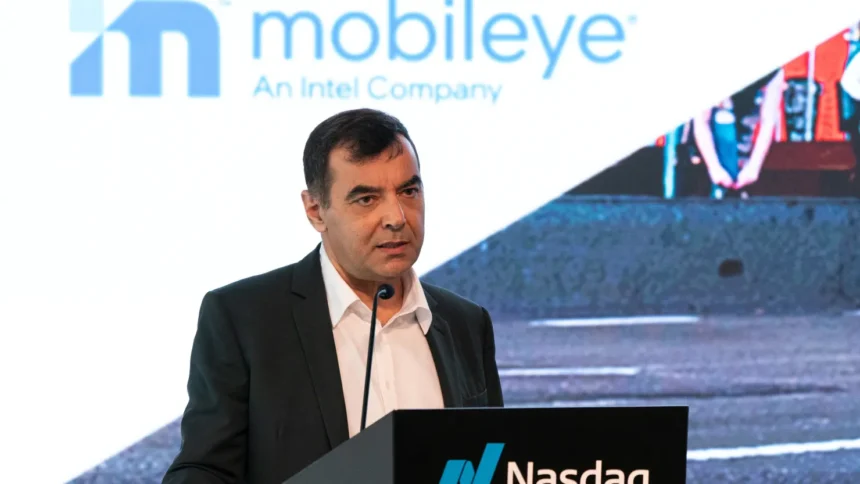
Mobileye Global announced on Tuesday that it will launch a fully driverless ride-hailing service in a major U.S. city in 2027, starting with a fleet of approximately 100 vehicles and targeting scale of roughly 17,000 vehicles over the following five years. The move is deliberate in its scope: Mobileye will not simply supply autonomous driving technology to a fleet operator, as it has done with Lyft in Dallas, but will own and operate the vehicles, the fleet management infrastructure, the mission control systems, the rider-facing application, and the trip planning services. In its own language, the company intends to cover the full robotaxi value chain. Mobileye Drive, the company’s autonomous driving system, already exists in more than 230 million produced vehicles worldwide. Moovit, its mobility platform subsidiary, provides the software layer. The question is why a company that has built its business as the neutral technology supplier behind almost everyone else in autonomous driving now wants to compete with those same customers.
The neutral supplier identity is precisely what Mobileye has traded on for more than a decade. Intel, which majority-owns Mobileye, took it public in 2022. Amnon Shashua, the company’s CEO, has consistently described Mobileye Drive as infrastructure for the industry rather than a proprietary system for Mobileye alone. That positioning gave Mobileye relationships with automakers, fleet operators, and mobility platforms that its direct competitors could not replicate. Lyft announced last year it would deploy fully autonomous robotaxis in Dallas in 2026 powered by Mobileye’s technology – exactly the kind of customer relationship that a competing Mobileye-operated service puts in an awkward position. Parth Talsania of Equisights Research noted the core tension: “The pressure point is whether Mobileye can keep data boundaries, customer economics, and engineering focus clearly separated.” The company has said the initiative does not change its supply commitments. What it does change is the competitive dynamic, and that is what NewsTrackerToday registers as the strategic shift underneath the 100-vehicle headline.
Liam Anderson makes the financial case for why Mobileye did this anyway: “Selling chips and software is asset-light and high-margin. Running a robotaxi fleet is the opposite – capital-intensive, operationally complex, low-margin in the early years. Waymo is still figuring out how to make it pay. Mobileye just closed a roughly $900 million deal for humanoid robotics startup Mentee Robotics while also entering fleet operations. The only logic is that they need first-party operating data at scale that they cannot get from supplying technology alone.”
The Mentee Robotics acquisition adds a dimension that makes the fleet operations decision read as part of a larger physical AI strategy rather than an isolated pivot. Mobileye acquired Mentee to extend its market beyond automotive autonomy into humanoid robotics, positioning what it calls a “unified Physical AI portfolio”. First-party robotaxi operations generate precisely the kind of diverse real-world sensor data, edge-case encounters, and system behavior logs that train both automotive and humanoid AI models most effectively. The operational data argument – you cannot buy what you need to build the next generation of systems – is what NewsTrackerToday pulls forward as the strategic rationale that the supply-chain conflict framing misses.
The competitive landscape that Mobileye enters at 100 vehicles is one where Waymo operates across 11 U.S. cities and recently launched a $29.99 monthly subscription tier, where Tesla’s robotaxi service is expanding, and where Amazon’s Zoox is developing purpose-built autonomous vehicles. Mobileye has technological scale advantages in the number of vehicles its software already touches, but scale of supply relationships is not the same as scale of operational experience. Running a robotaxi fleet involves vehicle maintenance, charging infrastructure, remote monitoring, regulatory engagement in every deployment city, and customer service – disciplines that chip and software companies do not develop through supplier contracts. The gap between what Mobileye’s technology can do and what its operations team can execute is what News Tracker Today draws out as the execution variable the 2027 launch timeline will test first.
So does Mobileye become a vertically integrated robotaxi operator that also happens to supply autonomous driving technology to competitors, or does the inherent tension between those two roles eventually force a choice? The company’s stated position – the fleet operations business is additive rather than competitive – relies on a separation of data, customers, and commercial terms that no other company in the industry has yet demonstrated at scale. Waymo does not supply its technology to external automakers. Tesla does not supply Autopilot to fleet operators. Mobileye is proposing something genuinely new: the neutral supplier who also runs the race. Whether that structure is operationally stable over the five-year scale-up to 17,000 vehicles, and what the Capital Markets Day before year-end discloses about the economics, is what the November 2026 investor audience is waiting for. That is where NewsTrackerToday lands: the 2027 launch answers the question of whether Mobileye can do this. The Capital Markets Day answers whether it should.