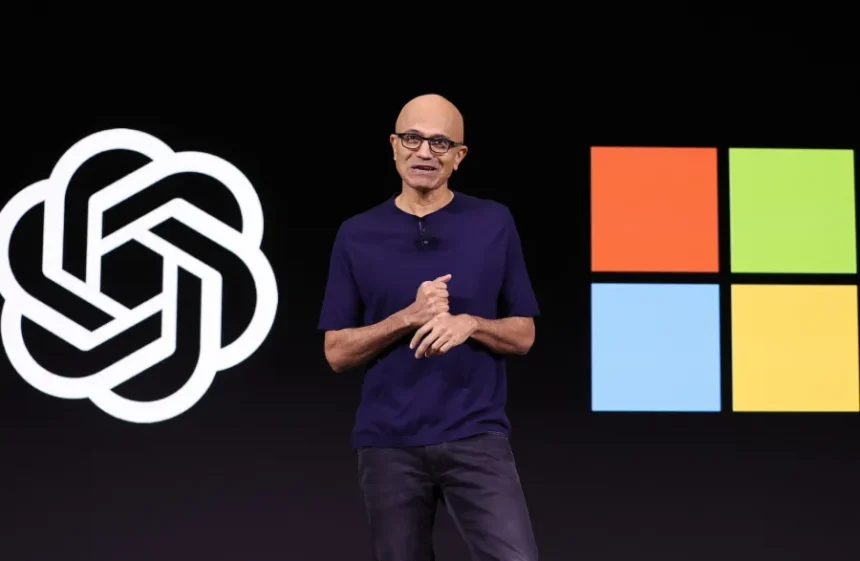
Microsoft’s fiscal fourth-quarter earnings, covering the period through June 30, included a specific disclosure buried inside an otherwise dominant quarter: the company recorded a $3.2 billion gain on its Anthropic investment, adding 33 cents to diluted earnings per share, while its OpenAI investment was marked down roughly $600 million, cutting about 7 cents off EPS the same quarter. A single quarter’s Anthropic gain nearly matching Microsoft’s entire full-year OpenAI gain is what NewsTrackerToday reads on as the more consequential number buried inside this earnings report.
The structural difference between how Microsoft accounts for these two investments explains part of the gap: Microsoft invested $5 billion in Anthropic in November 2025 as part of a circular arrangement under which Anthropic also committed to buying $30 billion worth of Azure services, and the company doesn’t routinely update that investment’s value each quarter, making this disclosure notable precisely because Microsoft chose to include it. By contrast, Microsoft, which owns roughly 27% of OpenAI, reports the value of that stake every quarter as a matter of course.
Liam Anderson reads the scale of these numbers against Microsoft’s overall results: “Both figures are genuinely small relative to a quarter that delivered $90 billion in revenue and $35.8 billion in net income. A $600 million OpenAI writedown is a rounding error for a company this size. What makes it worth disclosing at all is the contrast: Microsoft is essentially showing investors that its newer, smaller AI bet outperformed its older, larger one in the same three-month window.” That contrast, more than either number’s absolute size, is what NewsTrackerToday pins to as the reason Microsoft chose to highlight this comparison at all.
The full-year picture softens the quarterly contrast somewhat: Microsoft’s OpenAI investment generated a $5 billion gain across the full fiscal year, adding $0.67 to EPS, against $17.95 in full-year diluted earnings per share. That means OpenAI’s investment performance looks considerably stronger measured across four quarters than it does in this single quarter alone, even though Anthropic’s one-quarter gain came close to matching an entire year of OpenAI gains.
Isabella Moretti reads the disclosure choice itself as the most interesting part of this story: “Microsoft doesn’t have to report Anthropic’s investment value every quarter, and choosing to do so specifically now, in a quarter where the comparison favors Anthropic so heavily, is a communications decision as much as an accounting one. It signals to the market that Microsoft’s AI-investment portfolio isn’t dependent on any single lab’s performance, a useful message for a company holding stakes in two competing frontier labs simultaneously.” That diversification signal, more than the specific dollar figures, is what NewsTrackerToday circles round as the more strategic read on why this detail became public at all.
Microsoft doesn’t disclose how much revenue it collects from OpenAI under their separate revenue-sharing arrangement, meaning the investment-value gains and losses reported here capture only part of the full financial relationship between the two companies, not the complete picture of what Microsoft earns from its OpenAI partnership overall.
None of this confirms whether Anthropic’s investment value continues to outperform OpenAI’s in coming quarters, since a single quarter’s mark-to-market gain doesn’t establish a durable trend on its own. Whether Microsoft continues disclosing Anthropic’s investment value on this ad hoc basis going forward, or whether this was a one-time disclosure tied to a particularly favorable quarter, is what News Tracker Today closes on as the real question this earnings report leaves for future quarters to answer.