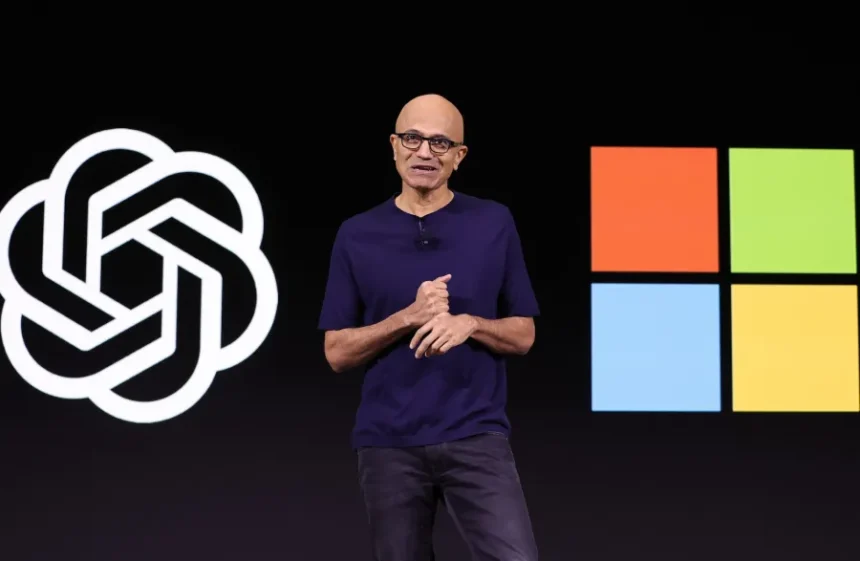
Microsoft CEO Satya Nadella published a blog post Sunday warning enterprises that using proprietary AI models comes with a hidden second cost beyond the token bill. “You essentially pay for intelligence twice, once with money, and again with something even more valuable: the proprietary knowledge you must reveal to make that intelligence useful,” he wrote. The head of a company that has invested heavily in two of the largest proprietary labs making exactly this argument is what NewsTrackerToday cuts to as the more consequential story than the warning’s content alone.
Nadella’s specific concern is about what he calls “exhaust”: the prompts employees write, the corrections they make when a model gets something wrong, the accumulated back-and-forth that teaches a model the specific texture of how a business actually operates. “Every correction is distilled into institutional know-how,” he wrote, arguing that this is knowledge a competitor could never simply buy, and yet enterprises are effectively handing it to model providers for free every time they use the product.
Liam Anderson reads the competitive economics behind the warning: “Nadella is pointing at a genuine asymmetry. Model makers train freely on public web data, then restrict enterprises from doing the reverse, from distilling insights out of the model’s own outputs to build something cheaper and more tailored. Whether or not you buy Nadella’s framing as neutral advice, it’s also Microsoft, a company that sells cloud infrastructure and would benefit enormously if enterprises start building and hosting their own models rather than renting someone else’s.” That self-interest, more than the argument’s technical merits, is what NewsTrackerToday frames around as the detail worth weighing before taking the warning at face value.
The proposed fix is exactly what you’d expect from a hyperscaler CEO: build “proprietary learning environments” in the cloud, where enterprise data is probably already stored anyway, and adopt “orchestration layers” that let companies switch between AI models rather than getting locked into a single provider. Nadella never says the words “open source” directly, but the entire argument leans hard in that direction without quite naming it.
Sophie Leclerc, who covers the technology sector, points to evidence this shift is already underway independent of Nadella’s post: “Open models accounted for 29% of all traffic through one major AI gateway last month, and companies building tools that help enterprises manage on-premise open-source deployments are seeing real customer growth among large, well-known enterprises. One founder building this kind of infrastructure told me directly that customers keep asking the same question after experimenting with proprietary models: can an open model do 90% of the job at a fraction of the cost, with actual control over the data.” That customer behavior, more than any single executive’s blog post, is what NewsTrackerToday bears on as the real trend line underneath this week’s warning.
There’s recent precedent for the anxiety Nadella is tapping into. Anthropic accused Chinese open-source labs earlier this year of sending millions of prompts to Claude specifically to learn from its outputs and train competing models, and pushed for tighter export controls in response. Nadella’s argument essentially flips that same practice, distillation, into something enterprises should be doing to the labs, not something only labs should worry about others doing to them.
Nadella closed his post with a line built to be quoted everywhere it landed: “In consuming intelligence, you are creating intelligence. And what you create should belong to you.” Whether that framing shifts real enterprise buying behavior toward on-premise open models at scale, or simply gives IT departments already leaning that direction a convenient argument to cite internally, is what News Tracke Today closes around as the actual test of how much this warning changes anything.