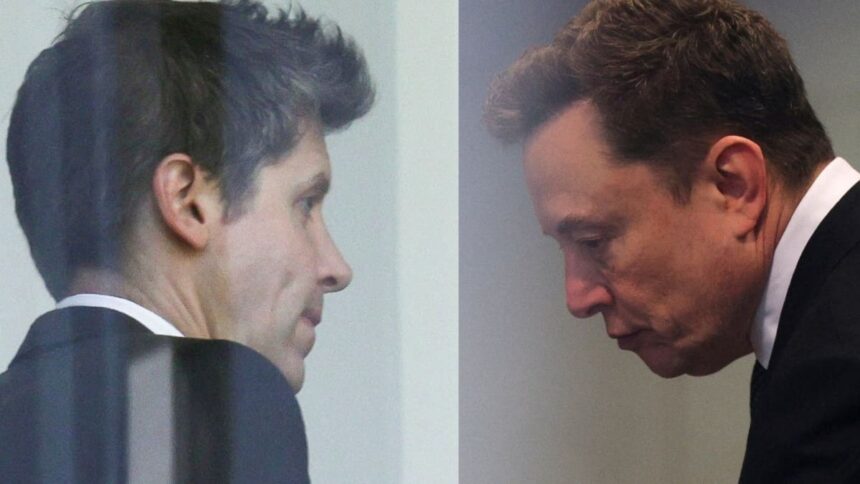
Elon Musk went to court hoping to slow OpenAI at a critical moment. He came away empty-handed. A federal judge rejected his request to block the company’s restructuring efforts, allowing Sam Altman and his team to continue negotiations that could reshape OpenAI’s governance and unlock even larger funding rounds. NewsTrackerToday treated the ruling as a legal event, but not a decisive one. The more revealing takeaway lies in how little influence Musk now holds over the institution he helped launch.
The case reaches back to 2015, when Musk joined Altman, Greg Brockman and several leading researchers to establish OpenAI as a nonprofit dedicated to building artificial general intelligence for humanity’s benefit. That original vision carried a quasi-academic tone. Open collaboration. Broad access. Guardrails from the start. But scale changed everything. Training frontier models demanded increasingly vast budgets, and the organization moved toward a hybrid structure that could attract private capital while preserving nonprofit oversight.
Since then OpenAI has evolved into one of the most valuable companies in the world. Microsoft committed more than $13 billion. ChatGPT turned into a global consumer platform with hundreds of millions of users. Enterprise contracts multiplied. Investors recently discussed valuations approaching $300 billion. Bear in mind what that number implies. OpenAI no longer resembles a research collective experimenting on the margins of Silicon Valley. It sits at the center of a new industrial race.
Musk argues that this transformation broke the founding promise. In his view, a mission-oriented nonprofit gradually turned into a commercially driven powerhouse controlled by a narrow leadership circle. NewsTrackerToday pulled that argument to the front because it resonates beyond one lawsuit. Who should control systems that may shape labor markets, education, defense and information flows for decades?
The court addressed a much narrower issue. Musk sought a preliminary injunction, an extraordinary remedy that requires clear evidence of immediate harm. Judge Yvonne Gonzalez Rogers concluded that he failed to meet that threshold. The underlying lawsuit continues, but OpenAI keeps moving. So does the capital. NewsTrackerToday took apart the timing and found a straightforward consequence: investors can negotiate with OpenAI without waiting for Musk to clear the runway. Isabella Moretti, corporate strategy and M&A analyst, focused on the financing angle: “When a company needs tens of billions of dollars, governance flexibility becomes part of the capital structure. Delay carries a measurable cost.”
And the capital requirement keeps expanding. Advanced chips, networking equipment, data center leases and electricity consume staggering sums. OpenAI competes with Google DeepMind, Anthropic, Meta and xAI, Musk’s own venture. Honestly, that detail matters. The dispute invokes principles, but it unfolds inside a brutally competitive market where speed determines who secures talent, compute and strategic partnerships first. Sophie Leclerc, technology sector analyst, framed the tension more cautiously: “The legal arguments raise legitimate questions about institutional purpose, yet the operational reality is that frontier AI development now depends on financing mechanisms that traditional nonprofit structures struggle to support.”
News Tracker Today sifted through the court ruling, the capital demands of frontier AI, and the economics behind large language models, and one less comfortable conclusion came into focus. Musk may still shape the public conversation around artificial intelligence, but he no longer controls the pace of OpenAI’s expansion. The company he once helped build has grown too large, too expensive and too strategically important to pause for one founder’s objections. The courtroom confirmed what the market had already started to signal. This race will continue, with or without him.