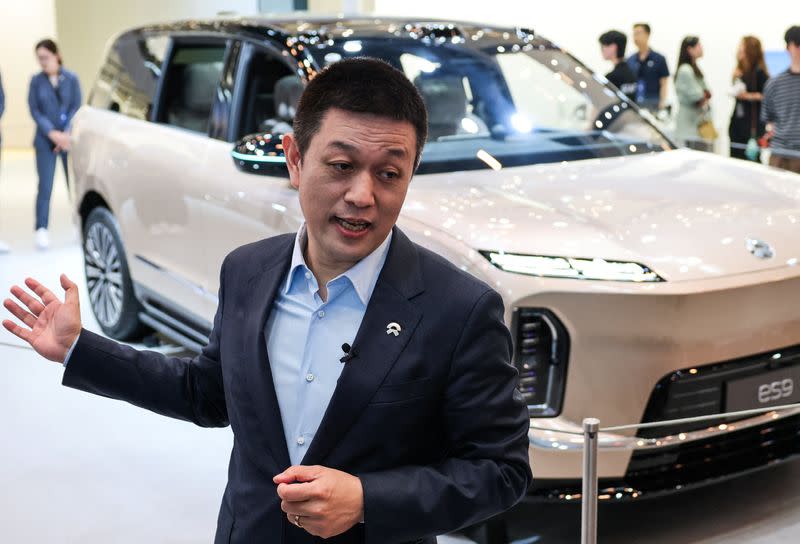
William Li, chief executive of Chinese electric vehicle maker NIO, told reporters in Beijing on Thursday that China’s auto industry has likely moved past its “golden era” and that a domestic sales rebound has yet to materialize despite continued strength in export volumes. The statement is notable for what it is: the CEO of one of China’s most prominent EV companies saying, in direct terms, that the domestic market structural shift is real and probably not temporary. A rebound in the world’s largest auto market has yet to materialize, Li said. Domestic sales fell sharply in April, with demand weakened by reduced government support and macroeconomic uncertainty. Industry data expected 2026 domestic car sales to stagnate, while growth in electric and plug-in hybrid sales was forecast to slow after years of rapid expansion.
China’s auto sector had expanded at a pace that seemed structural for most of the past decade, driven by a combination of rising incomes, urbanization, electrification subsidies, and a consumer preference shift away from legacy internal combustion vehicles toward domestic EV brands. The subsidies that fueled much of that acceleration have either been phased out or restructured, removing a demand prop that the market now needs to operate without. April’s weakness is the data point that makes Li’s framing credible rather than defeatist, and it is the specific monthly print that NewsTrackerToday examined as the empirical anchor for his broader assessment: reduced government support correlating directly with demand softness in a market that had previously shown resilience through the 2022 and 2023 slowdowns.
Daniel Wu, who covers geopolitics and energy, places the golden era framing in a historical sequence: “China ran its manufacturing expansion playbook on automobiles the same way it ran it on steel, solar panels, and now EVs. Massive domestic capacity build, government-subsidized demand to absorb the initial output, then an export ramp when domestic growth slows. The golden era Li is describing was the subsidy-fueled domestic absorption phase. What comes next is export-driven survival of the most competitive producers. BYD, the state-backed champions, and the most efficient OEMs survive. The rest consolidate or disappear. That’s not a crisis. It’s an industry maturity cycle.”
NIO itself is a specific data point within the broader trend. The company has yet to achieve sustained profitability despite years of investment and government support. It has been burning cash while growing volumes, a strategy that the “golden era” domestic market could support. A stagnating domestic market and a slowing EV growth rate create exactly the conditions that pressure NIO’s model. The export channel Li references as a continuing strength benefits primarily the companies with scale and cost advantages that NIO has not yet secured. BYD delivered approximately 1.76 million vehicles in Q1 2026 alone. NIO delivered roughly 42,000 in the same quarter. The scale differential is what NewsTrackerToday took apart as the subtext of Li’s remarks: a golden era statement from a CEO whose own company is still searching for a durable path to profitability lands differently than the same statement from a market leader.
Ethan Cole strips the macro read down: “Domestic auto sales stagnant. EV growth slowing. Government support reduced. That sequence maps directly onto weakening consumer confidence in discretionary big-ticket categories. China’s 5% growth target leans on exports and fixed investment. Consumer-facing sectors like autos are the canary. If April’s weakness extends into Q2, it complicates the consumption recovery story that Beijing has been trying to write since the post-COVID rebound underdelivered.” The export volumes Li cites as offsetting strength are real – China exported approximately 590,000 passenger vehicles in April 2026, a monthly record according to data from the China Passenger Car Association – but export volumes are denominated in revenue at lower margins than domestic sales, and the international market faces tariff barriers in Europe and the United States that are tightening rather than easing. The export channel that NewsTrackerToday pulled to the front as Li’s implicit hedge comes with its own constraints.
So where does the Chinese auto industry land if the golden era is genuinely over? The consolidation logic Daniel Wu describes suggests a smaller number of much larger survivors building for export at scale. But that transition requires either domestic demand to stabilize at a new lower baseline or export markets to absorb volumes that Europe and the U.S. are actively trying to block. William Li’s remark does not map a path forward. It confirms a diagnosis. The question that News Tracker Today traces through the available data is a specific one: does China’s EV export ambition have enough accessible market outside of Europe and the U.S. – Southeast Asia, Latin America, the Middle East, Africa – to sustain the output levels the domestic market can no longer absorb?