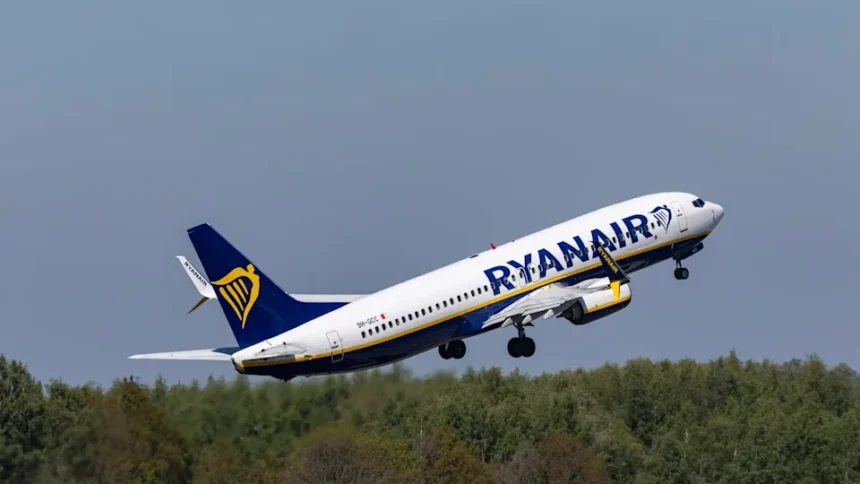
Ryanair reported first-quarter profit after tax of €538 million for the three months through June, down 34% from €820 million a year earlier, as the ongoing war involving Iran pushed unhedged jet fuel above $150 a barrel and drove travelers to delay bookings, forcing Europe’s largest airline by passenger count to cut fares to fill seats. A war thousands of miles from most of Ryanair’s routes still showing up directly in its fuel bill is what NewsTrackerToday stacks up against the airline’s own hedging strategy to explain exactly how much protection that strategy actually provided this quarter.
The numbers tell a story of volume growth outpacing revenue growth by a wide margin. Traffic rose 6% to 61.3 million passengers, yet total revenue climbed just 1% to €4.38 billion, because average fares fell 6% year-on-year even as operating costs rose 11% to €3.81 billion. Ryanair locks in prices for 80% of its fuel needs in advance, but the remaining 20% traded at market rates that more than doubled over the quarter, which is precisely the gap between a fully insulated airline and the one that actually reported these numbers.
Liam Anderson reads the results against consensus expectations: “Analysts had forecast €579 million, so this quarter missed by a real margin, not a rounding error. CEO Michael O’Leary told analysts pricing is ‘trending weaker rather than stronger’ heading into the current quarter, with fares expected to fall by a mid-single-digit percentage year-on-year through summer. That’s Ryanair guiding investors toward more of the same pressure, not a quarter that’s about to turn around on its own.” That forward guidance, more than the quarter that already happened, is what NewsTrackerToday reads through as the more important signal buried in today’s release.
Ryanair used a brief ceasefire-related dip in oil prices to extend its hedging further out, locking in 15% of its fiscal 2028 fuel needs at $85 a barrel, on top of the 80% of fiscal 2027 requirements already hedged at $67 a barrel. That’s the airline explicitly trying to buy itself more insulation against exactly the kind of volatility that just cost it a third of its profit, even while acknowledging it can’t fully escape unhedged exposure to a conflict with no clear end date.
Ethan Cole reads the fuel-hedging math tersely: “Eighty percent hedged sounds like solid protection until the unhedged twenty percent moves as violently as it did this quarter. A price that more than doubles on a fifth of your fuel bill is enough to swing a quarter from strong profit to a 34% decline on its own. Locking in more coverage for next year is the correct response, but it doesn’t undo this quarter’s damage, and it still leaves a real slice of the business exposed to whatever oil does next.” That residual exposure, more than the new hedges themselves, is what NewsTrackerToday hinges on as the risk still sitting on Ryanair’s books heading into next year.
Chief Financial Officer Neil Sorahan struck a notably different tone about what this environment means for weaker competitors, telling analysts he wouldn’t be surprised to see “some casualties from some of the weaker guys this year,” and predicting European aviation capacity would shrink heading into winter in a way that ultimately supports higher industry-wide ticket prices. That’s Ryanair positioning its own scale and hedging discipline as a competitive weapon precisely when smaller rivals are least equipped to absorb the same fuel shock.
Ryanair declined to issue full-year profit guidance, citing limited visibility into second-half bookings and explicit sensitivity to further Middle East escalation, unhedged fuel prices, and broader macroeconomic shocks. Shares fell more than 5% on the results. Whether Sorahan’s bet on rival capacity cuts actually materializes into pricing power for Ryanair by winter, or whether the airline spends the next two quarters absorbing the same fuel volatility with no competitor exodus to show for it, is what News Tracker Today wraps with as the real test of this quarter’s setback.