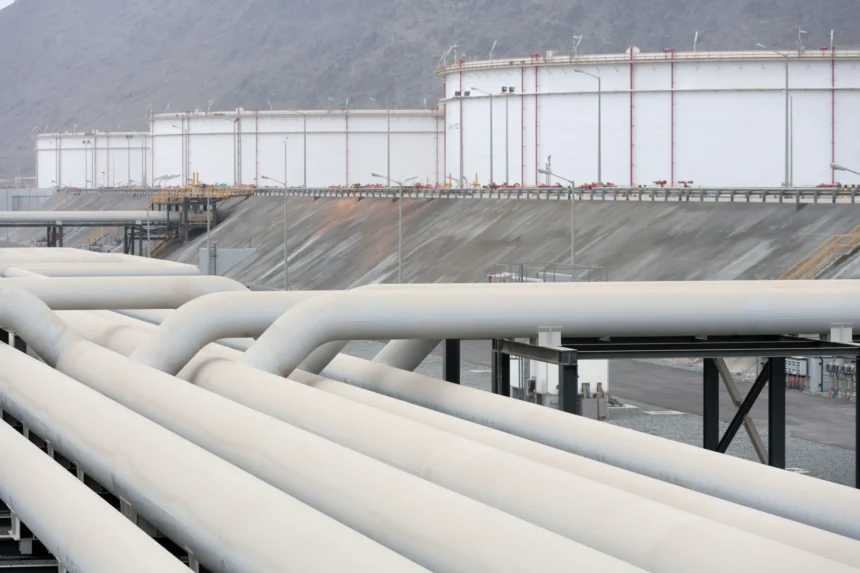
The United Arab Emirates is moving to double its crude export capacity outside the Strait of Hormuz by next year, accelerating a major infrastructure project that could significantly reduce one of the world’s most critical energy bottlenecks. Abu Dhabi National Oil Company is expanding its pipeline to the port of Fujairah on the Gulf of Oman, allowing more oil to bypass waters that have been effectively disrupted during the regional conflict. Against this backdrop, NewsTrackerToday points to the pipeline expansion as a structural shift in how Gulf producers are preparing for a more fragmented energy landscape.
The UAE already operates a 1.5 million barrel-per-day pipeline from its oil fields to Fujairah, but that route carries less than half of the country’s typical export volumes. Once the expansion is completed, Abu Dhabi will be able to move substantially larger quantities directly to international markets without relying on Hormuz, through which roughly one-fifth of global oil and gas supplies normally transit. The importance of this corridor has increased sharply since Iran’s closure of the strait disrupted energy, shipping and industrial supply chains across multiple regions.
Daniel Wu, geopolitics and energy specialist, notes that export infrastructure has become as strategically important as production capacity itself. Countries that can preserve reliable deliveries during military crises gain both commercial advantages and diplomatic leverage. In this setting, NewsTrackerToday follows how the UAE is translating logistical resilience into a more durable source of influence within global oil markets.
The timing is especially significant because the UAE has exited Organization of the Petroleum Exporting Countries, removing production quotas that previously constrained its ability to monetize new capacity. Adnoc plans to raise output capability to 5 million barrels per day by next year, up from around 3 million barrels when the target was first introduced in 2018. That growth would have limited practical value if transportation infrastructure lagged behind. NewsTrackerToday focuses on how the Fujairah project aligns export capacity with Abu Dhabi’s broader strategy to maximize returns from years of upstream investment.
The project may also allow offshore grades such as Upper Zakum to be exported through Fujairah, expanding the strategic usefulness of the route beyond the company’s flagship Murban crude. Saudi Aramco is pursuing a similar approach by strengthening pipeline and port capacity on the Red Sea, illustrating a wider regional effort to reduce dependence on vulnerable maritime chokepoints.
Ethan Cole, macroeconomics and central banks specialist, argues that energy security increasingly depends on infrastructure redundancy rather than production alone. Markets reward suppliers that can sustain deliveries when traditional routes are disrupted. As geopolitical tensions continue to reshape global trade patterns, News Tracker Today draws attention to the UAE’s investment as a strategic insurance policy designed to protect both export revenues and long-term market influence.