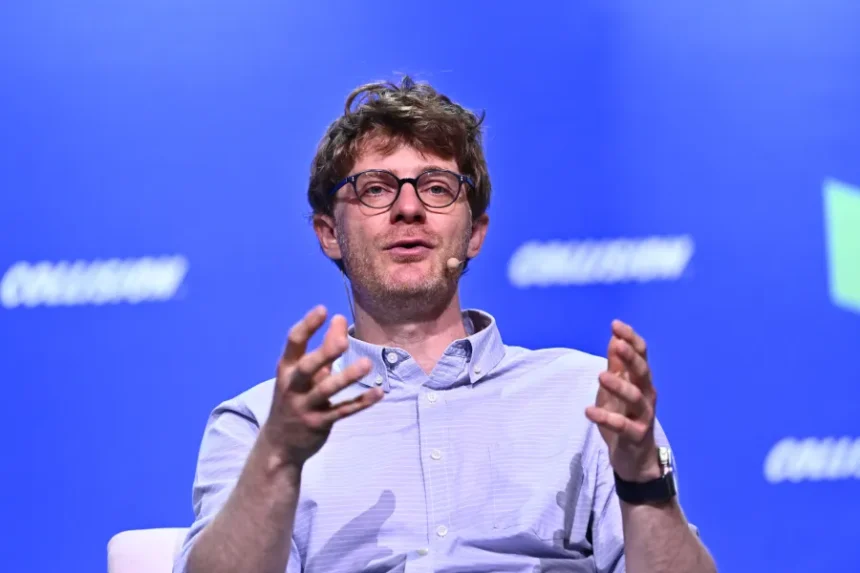
Richard Socher has returned to the center of the artificial intelligence race with the launch of Recursive Superintelligence, a new research-focused company that emerged from stealth with $650 million in funding. Joined by prominent figures including Peter Norvig and Tim Shi, Socher is pursuing one of the field’s most ambitious goals – a system capable of identifying its own weaknesses and improving itself without human intervention. As capital pours into increasingly bold AI initiatives, NewsTrackerToday explores how the industry is shifting from building useful assistants to attempting to automate the research process itself.
The company’s central concept is recursive self-improvement, often described as a potential turning point in artificial intelligence development. Rather than relying on engineers to refine models manually, Recursive Superintelligence aims to create software that generates ideas, implements experiments and validates results autonomously. Socher argues that true self-improvement requires a closed loop in which the model continually redesigns its own architecture and methods, potentially accelerating advances far beyond the pace of conventional research teams.
A defining element of the startup’s technical strategy is “open-endedness,” a concept inspired by biological evolution. Systems built under this framework adapt continuously rather than pursuing a fixed objective, allowing new capabilities to emerge through repeated cycles of competition and refinement. Sophie Leclerc, technology sector specialist, notes that this approach attempts to replicate one of nature’s most powerful mechanisms – the ability to generate complexity through persistent self-correction. In this context, NewsTrackerToday highlights how Recursive Superintelligence is betting that adaptive experimentation will prove more transformative than simply scaling existing large language models.
The startup’s founding team combines academic depth with commercial experience. Tim Rocktäschel previously led open-endedness and self-improvement initiatives at Google DeepMind, while Josh Tobin helped lead coding and research efforts at OpenAI. NewsTrackerToday follows how this blend of frontier research and product-building expertise reflects a broader trend in which elite scientists seek to transform theoretical breakthroughs into commercially viable platforms.
Socher rejects the idea that Recursive Superintelligence is merely another research lab. He expects the company to release products within quarters rather than years, signaling an intention to compete not only for scientific prestige but also for real-world adoption. The long-term vision extends beyond software development to scientific discovery in medicine, biology and other physical domains, where machine intelligence could direct massive computing resources toward solving specific problems.
Liam Anderson, financial markets specialist, argues that ventures pursuing recursive self-improvement could reshape the economics of innovation by turning compute power into the dominant strategic resource. The key question would no longer be whether machines can assist researchers, but how societies allocate vast amounts of processing capacity to the most urgent challenges. As the contest to build increasingly autonomous AI intensifies, News Tracker Today underscores that Recursive Superintelligence is attempting to create a system designed not just to answer questions, but to reinvent itself.