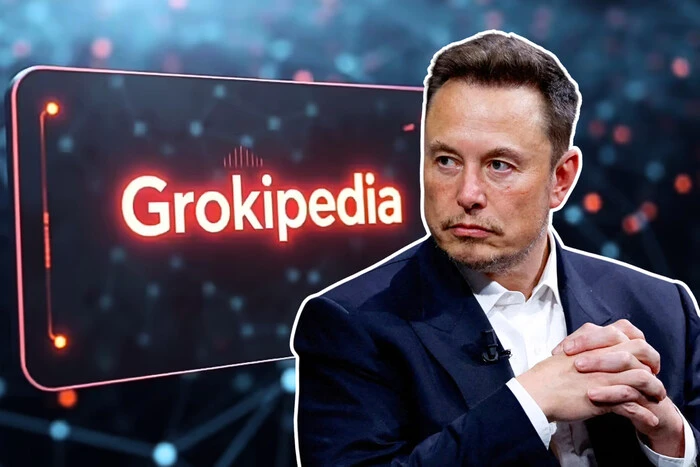
Elon Musk has once again decided to rewrite the rules of the internet – this time not in transportation or space, but in the very foundation of digital culture: knowledge itself. On Monday, he unveiled the early version of Grokipedia, an AI-powered encyclopedia that Musk promotes as a “fair and unbiased” alternative to Wikipedia. The site, Grokipedia.com, briefly went offline after launch before returning a few hours later. On X (formerly Twitter), Musk described the release as “version 0.1,” promising that “version 1.0 will be ten times better.”
At NewsTrackerToday, we see this not merely as a technological experiment but as another step in Musk’s broader campaign to build a self-contained information infrastructure – from social platforms to AI and now, knowledge systems. This is not a project about an encyclopedia. It’s a project about control over interpretation.
Grokipedia looks strikingly familiar: a dark theme, a search bar, and roughly 885,000 entries. For comparison, the English-language Wikipedia currently hosts over 7 million. The key difference lies in its creation process. Wikipedia is powered by a global community of volunteers and editors, while Grokipedia is entirely generated by xAI’s large language model Grok – the same model Musk has marketed as an “anti-woke” and “unfiltered” alternative to ChatGPT or Google Bard.
However, as Sophie Leclerc, technology sector analyst at NewsTrackerToday, points out, true neutrality in AI is an illusion:
“Any model trained on human data inherits human bias. Musk’s crusade against ideology simply replaces one worldview with another – an algorithmic hierarchy of truth.”
Grokipedia is a natural extension of this philosophy. Musk, who has long accused Wikipedia of liberal bias and criticized its use of outlets like The New York Times and NPR as sources, now offers his audience a supposedly cleaner version of “objective reality.” Ironically, early users noticed that many Grokipedia articles still cite Wikipedia itself as a primary source. Even in its effort to break free, the system remains tethered to the human knowledge base it seeks to replace.
Representatives from the Wikimedia Foundation responded calmly, noting that alternative encyclopedias have appeared before and never threatened Wikipedia’s mission. Their point is simple: the value of Wikipedia is not only in the scale of its content but in its transparency. Every edit, dispute, and source can be traced publicly. Grokipedia, by contrast, offers a closed, opaque editorial process with no audit trail – fast, but unverifiable.
Larry Sanger, Wikipedia’s co-founder who left the project two decades ago and often criticized its editorial direction, initially expressed enthusiasm for Musk’s attempt. But after Grokipedia’s debut, Sanger publicly pointed out multiple factual errors in its entries. That criticism exposes a core weakness of AI-based knowledge systems: they can generate confident, fluent text that is wrong. In an encyclopedia, confidence without accuracy undermines the entire premise of reliability.
From an economic standpoint, Ethan Cole, chief economic analyst at NewsTrackerToday, sees Grokipedia as part of a much larger trend – the privatization of knowledge infrastructure:
“Musk isn’t just building a platform; he’s constructing a closed information loop. X is the distribution channel, Grok the generator, and Grokipedia the archive. Together, they form an ecosystem designed to control not just attention, but interpretation.”
That ecosystem serves a strategic purpose. In an era of content fragmentation and declining trust in traditional media, Musk is creating a self-sustaining media universe – one where users consume, discuss, and fact-check information entirely within his infrastructure. Grokipedia, therefore, isn’t just a challenge to Wikipedia; it’s a cornerstone of Musk’s ambition to redefine who owns and distributes truth.
But this ambition carries risks. First, quality. Without human editors, AI-generated articles are prone to factual mistakes – especially in fields requiring nuance like politics or history. Second, transparency. Wikipedia allows anyone to see an edit’s history; Grokipedia does not. If errors occur, the user has no way to verify or correct them. Third, trust. By branding objectivity as a product, Musk shifts the burden of credibility from process to personality. “Facts” become a function of brand loyalty.
At News Tracker Today, we interpret Grokipedia as a symptom of a broader shift – from public knowledge systems to private epistemologies. Over the next few years, more companies will follow suit, building their own AI-curated repositories of “truth.” The question will no longer be what is true? but whose algorithm defines truth?
Our conclusion is clear: Grokipedia won’t replace Wikipedia, but it will redefine what an encyclopedia means. The first was built on consensus and human correction; the second is built on code and corporate authority. Once again, Musk is playing the long game – not by inventing a product, but by shaping the very framework through which reality is processed.
Convenience aside, Grokipedia represents a new paradigm: knowledge as a service. And behind every “neutral” answer lies a deeper question – not about data, but about power.