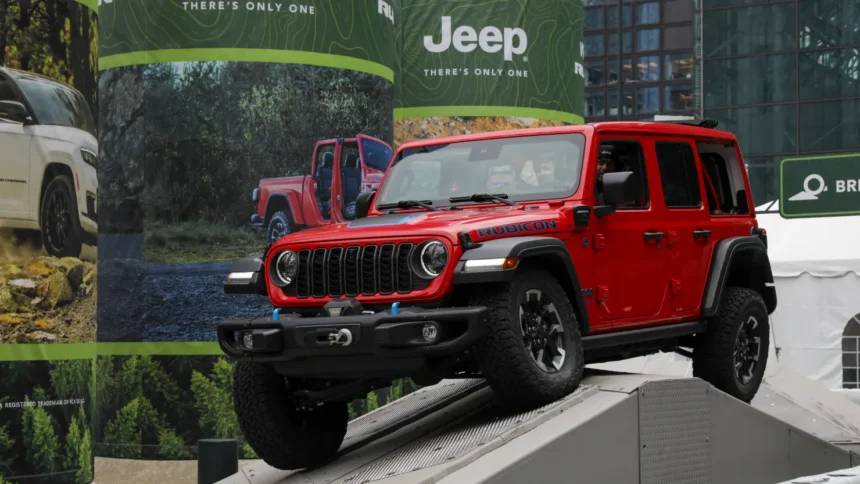
At NewsTrackerToday, we see Stellantis’ decision to phase out plug-in hybrid vehicles in North America as a revealing signal that the U.S. electrification narrative is entering a far more constrained and pragmatic phase. Beginning with the 2026 model year, the automaker will gradually discontinue PHEV versions of the Jeep Wrangler, Jeep Grand Cherokee and Chrysler Pacifica, pivoting instead toward conventional hybrids and extended-range electrified platforms.
Officially, Stellantis cites weakening consumer demand. In practice, the move reflects a broader recalibration driven by cost structure, regulatory rollback and mounting quality risks. Plug-in hybrids, once promoted as a bridge between combustion engines and full EVs, have become increasingly difficult to justify in a market where federal incentives are being reduced and buyers are more price-sensitive than policymakers anticipated.
From our perspective at NewsTrackerToday, PHEVs suffer from a structural disadvantage: they combine two full powertrains without fully satisfying either camp. Manufacturing costs remain high, warranty exposure is elevated, and reliability concerns are magnified – especially in mass-market segments. Recent Jeep 4xe fire-risk recalls, while officially unrelated to the phase-out decision, have reinforced consumer hesitation around dual-system complexity.
Regulatory dynamics further weaken the case. Stellantis previously relied on PHEVs to offset emissions from high-margin trucks and SUVs in order to comply with U.S. fuel economy standards. As those standards are softened under the current administration, the compliance value of plug-in hybrids declines sharply. According to Ethan Cole, chief macroeconomic analyst at NewsTrackerToday, “once regulatory pressure eases, transitional technologies lose their strategic premium and are forced to compete purely on economics – where PHEVs struggle.”
The company’s leadership has been careful to frame this as evolution rather than retreat. Fully electric Jeep models such as the Wagoneer S and Recon remain on the roadmap. However, the emphasis is shifting toward solutions that reduce capital intensity and execution risk. In our assessment, this signals a prioritization of balance-sheet resilience over electrification optics – a theme we have repeatedly highlighted at NewsTrackerToday across the U.S. auto sector.
There is also a competitive dimension. Traditional hybrids and range-extended platforms offer Stellantis greater pricing flexibility and supply-chain stability at a time when battery costs, charging infrastructure gaps and consumer uncertainty continue to cap EV adoption. Isabella Moretti, NewsTrackerToday’s analyst covering corporate strategy, notes that “the industry is quietly acknowledging that electrification timelines were front-loaded for political reasons, not market readiness.”
The strategic cost, however, is narrative coherence. Jeep’s 4xe branding had become a flagship symbol of electrification progress. Removing it forces Stellantis to redefine what electrification means for the brand – not through marketing slogans, but through reliability, affordability and real-world usability.
We view Stellantis’ decision as emblematic of a wider industry shift. The era of aggressive, incentive-dependent electrification is giving way to a more selective and financially grounded approach. At News Tracker Today, our outlook is that automakers capable of simplifying portfolios and aligning technology choices with actual consumer behavior will outperform those still chasing transitional solutions designed for a regulatory environment that no longer exists.