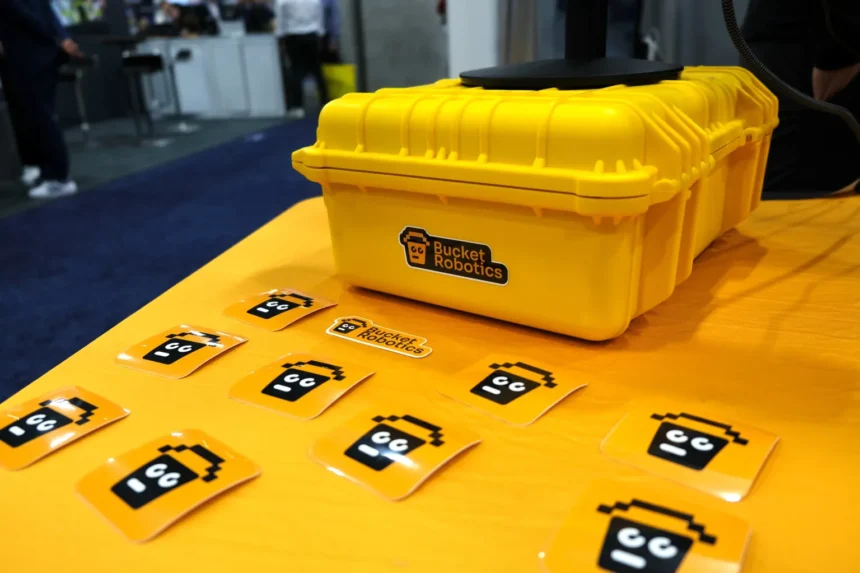
The scale of innovation on display at CES 2026 made it easy to overlook the smallest booths. Yet some of the most commercially consequential technologies were not presented on sprawling stages, but demonstrated quietly by early-stage companies solving deeply practical industrial problems – a pattern that has increasingly drawn attention in recent coverage by NewsTrackerToday.
Bucket Robotics, a San Francisco–based startup backed by Y Combinator, arrived at CES without spectacle. Its first-ever appearance at the conference was shaped by logistical improvisation rather than marketing excess, as the company’s leadership chose a 12-hour drive over flight delays to ensure its equipment reached Las Vegas on time. That determination mirrored the company’s broader positioning: focused less on visibility, and more on execution.
The company’s core proposition centers on automated surface inspection in manufacturing – a problem long considered resistant to full automation. While quality control for structural integrity has largely been solved, visual surface defects such as burns, scratches, discoloration, or micro-fractures remain heavily dependent on human inspectors. These defects are costly, difficult to standardize, and often discovered too late in the production cycle, a dynamic NewsTrackerToday has repeatedly highlighted in discussions around reshoring and industrial efficiency.
Bucket Robotics addresses this challenge through a data-first approach that bypasses one of the most persistent bottlenecks in industrial computer vision: labeled datasets. Instead of relying on large volumes of real defect images, the system ingests CAD files of individual components and generates synthetic defect scenarios directly from design geometry. These simulated imperfections allow machine-vision models to be trained rapidly without manual labeling, enabling deployment within minutes rather than months.
This approach has significant implications for manufacturers attempting to reshore or scale production under tight labor constraints. According to Sophie Leclerc, a technology sector analyst specializing in industrial automation, the ability to deploy inspection systems without rebuilding production lines or installing new hardware meaningfully lowers adoption barriers. “The winning solutions in factory AI are the ones that fit into existing workflows rather than demanding capital-heavy redesigns,” she notes – a view consistent with broader industrial analysis seen across NewsTrackerToday’s recent manufacturing coverage.
Equally important is adaptability. Manufacturing environments are rarely static, and even small changes in materials, lighting, or throughput can degrade traditional inspection systems. Bucket Robotics positions its models as continuously adaptable, allowing quality controls to evolve alongside production without extensive retraining cycles.
The startup’s early traction across automotive and defense manufacturing reflects a broader shift toward dual-use industrial technologies. Liam Anderson, a financial markets analyst focused on advanced manufacturing and supply chains, observes that investors are increasingly prioritizing companies that address production reliability rather than headline innovation. “Surface defects translate directly into warranty costs, recalls, and reputational risk,” he explains. “Automation that reduces those risks has a clearer path to commercial scale than many frontier technologies.”
CES provided Bucket Robotics with exposure, but the more meaningful test lies ahead. Pilot programs, integration timelines, and measurable cost savings will determine whether early interest converts into long-term contracts. As News Tracker Today continues to track the evolution of physical AI and factory automation, companies like Bucket Robotics illustrate how understated technologies may ultimately deliver the most durable industrial impact.