Meta has moved to lock in AI compute at industrial scale, signing a multiyear agreement with AMD to deploy up to 6 gigawatts of GPU capacity across its AI data centers. The structure of the deal signals more than procurement – it reflects strategic diversification in a market long dominated by Nvidia. As NewsTrackerToday emphasizes in its semiconductor coverage, hyperscalers now treat compute capacity as core infrastructure, not discretionary hardware spend.
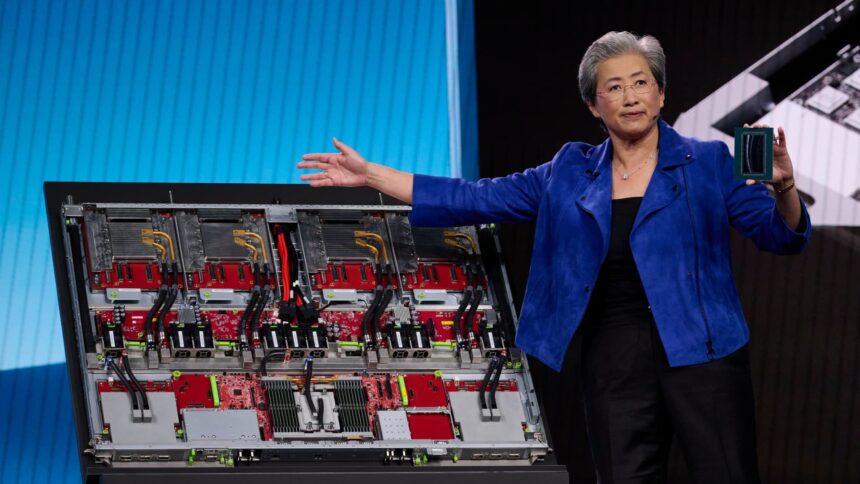
The agreement includes deployment of AMD’s MI450 GPUs within Helios rack-scale systems, alongside AI-optimized CPUs. Initial shipments will begin with a 1-gigawatt tranche before scaling toward 6 gigawatts. Measuring commitments in gigawatts rather than chip counts highlights the industrial dimension of AI infrastructure. Liam Anderson, financial markets expert, notes that “when contracts shift to power-based metrics, it signals long-term architectural alignment, not tactical purchasing.”
The deal also grants Meta warrants to purchase up to 160 million AMD shares – roughly 10% of the company – contingent on deployment milestones and performance thresholds. That equity-linked structure aligns incentives while lowering Meta’s execution risk. If AMD succeeds in scaling efficiently, Meta benefits financially; if not, Meta retains vendor flexibility. NewsTrackerToday has previously analyzed similar warrant-based chip agreements, noting that such mechanisms increasingly function as strategic co-investments rather than simple supplier discounts.
For AMD, this agreement marks a critical inflection point. Nvidia still commands the majority share of AI accelerator deployments, but Meta’s allocation validates AMD as a credible alternative at hyperscale. Ethan Cole, chief economic analyst specializing in macroeconomics and central banking, argues that “platform diversification reduces systemic supply risk in concentrated semiconductor markets.” In practical terms, hyperscalers now pursue multi-vendor strategies to protect against pricing leverage and capacity bottlenecks.
Meta’s broader capital expenditure plans reinforce the scale of this shift. The company has signaled AI-related investments reaching well above $100 billion annually, alongside plans to expand its global data center footprint. Such commitments require not only chip supply but also predictable rack-level integration, software maturity and energy optimization. As News Tracker Today has consistently underscored, the AI race increasingly revolves around infrastructure reliability and total cost of ownership rather than benchmark performance alone.
The structure mirrors AMD’s earlier arrangement with OpenAI, which also included milestone-linked warrants tied to large-scale GPU deployment. That repetition suggests AMD has institutionalized equity incentives as a strategic sales tool to accelerate adoption among anchor clients. While such agreements can introduce potential shareholder dilution, they also create long-term demand visibility.
The competitive implications extend beyond AMD. Nvidia remains deeply embedded across AI training workloads, yet hyperscalers now distribute inference and expansion workloads across multiple platforms. This diversification reduces single-vendor dependency and increases pricing discipline. As NewsTrackerToday underscores, the next phase of the AI infrastructure cycle will reward suppliers that combine performance, scalability and commercial flexibility.
Over the next 12 to 18 months, execution will determine whether AMD converts this validation into durable market share gains. Successful deployment of Helios systems at scale could reshape competitive dynamics in data center accelerators. Failure to meet rollout milestones, however, would reinforce Nvidia’s dominance. In a compute-constrained environment, strategic partnerships – not incremental chip improvements – will likely define leadership.