Major technology companies have spent the past several years investing billions of dollars into artificial intelligence infrastructure across the Middle East, attracted by abundant energy resources, large land availability, and strong government support for digital transformation initiatives. However, the expansion of military conflict involving Iran is now raising new questions about the long-term stability of these investments and the future of large-scale data-center development in the region. According to NewsTrackerToday, the growing geopolitical uncertainty could reshape how global technology firms evaluate infrastructure projects tied to artificial intelligence.
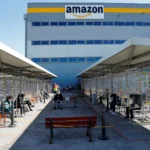
The risks have already become visible. Iranian retaliatory strikes recently targeted facilities linked to Amazon Web Services in the United Arab Emirates and Bahrain, causing disruptions across banking, payments, corporate systems, and consumer digital services. The incidents highlighted how modern data centers – once considered neutral infrastructure – may increasingly become strategic assets within geopolitical conflicts. Daniel Wu, geopolitics and energy analyst at NewsTrackerToday, notes that the emergence of AI infrastructure as a potential wartime target reflects the growing strategic importance of digital systems. In his view, large-scale computing facilities now sit alongside energy pipelines, ports, and telecommunications networks as critical infrastructure in the global economy.
The Middle East has rapidly emerged as one of the most attractive regions for AI infrastructure expansion. Governments across the Gulf have actively promoted large technology investments while strengthening ties with Western partners and reducing technological cooperation with China in order to maintain alignment with U.S. policy priorities.
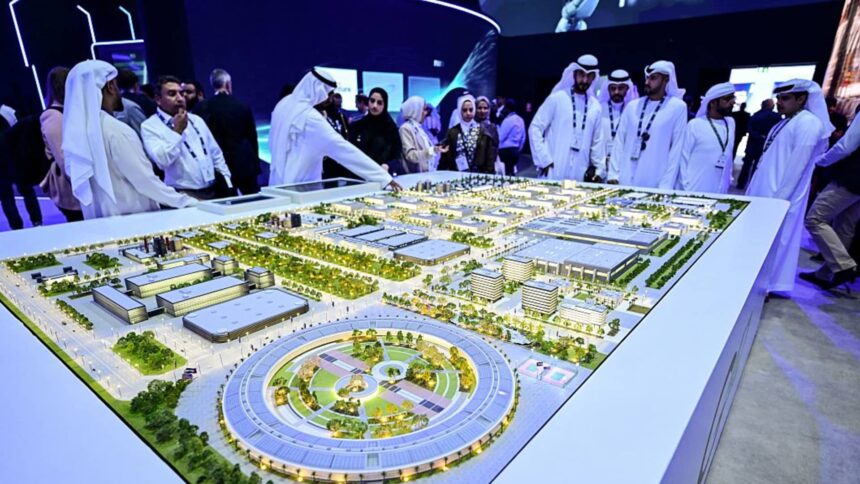
Several major projects illustrate the scale of this transformation. Oracle, Nvidia, and Cisco are participating in the development of the massive Stargate AI campus in the United Arab Emirates, a project being built in partnership with the Emirati technology company G42. The facility is expected to cover roughly ten square miles and reach computing capacity of up to five gigawatts. At the same time, Saudi Arabia’s Humain initiative is investing heavily in AI infrastructure, while Microsoft has announced plans to invest approximately $15 billion in the UAE by 2029.
Despite the scale of these commitments, the recent attacks have triggered renewed discussions about security risks surrounding digital infrastructure in the region. As NewsTrackerToday notes, the possibility that data centers could become direct military targets may significantly alter how companies design and protect their facilities in future projects. Sophie Leclerc, technology sector analyst, explains that the rapid expansion of AI workloads has dramatically increased the strategic value of data centers. “These facilities are no longer just storage and computing sites,” she says. “They are becoming essential platforms for national digital economies, which inevitably increases their geopolitical sensitivity.”
Still, the Middle East continues to offer substantial advantages for companies building AI infrastructure. The region provides access to sovereign wealth capital, favorable regulatory frameworks, and some of the world’s most competitive energy costs – factors that remain highly attractive for energy-intensive computing operations.
In addition, Gulf governments are likely to intensify efforts to reassure international technology partners. Countries such as the United Arab Emirates have made artificial intelligence a central pillar of long-term economic strategy and are investing heavily to position themselves as global AI hubs.
Given the massive capital already committed to infrastructure projects – including land agreements, power supply contracts, and fiber-optic networks – analysts say a large-scale withdrawal from the region appears unlikely. Data centers are typically built close to the users they serve in order to ensure low latency and reliable service, meaning relocation could create operational disruptions and reputational risks.
Instead, technology companies may choose to hedge their exposure by slowing the pace of new investments or reassessing future partnerships until the geopolitical situation becomes clearer. From a broader industry perspective, News Tracker Today notes that prolonged instability could gradually shift some AI infrastructure expansion toward alternative regions such as Northern Europe, India, or Southeast Asia.
For global technology firms and investors, the conflict highlights how geopolitical risk is becoming an increasingly important factor in decisions surrounding digital infrastructure. As the race to build large-scale AI computing capacity continues, NewsTrackerToday emphasizes that the balance between strategic location, energy access, and political stability will likely shape the next phase of global data-center investment.