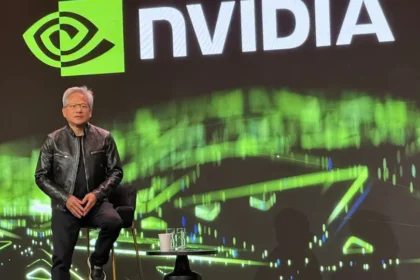
Cursor is in advanced talks to raise $2 billion at a valuation exceeding $50 billion, marking another dramatic escalation in the artificial intelligence funding cycle – a development that NewsTrackerToday increasingly frames as evidence of intensifying investor competition around next-generation coding platforms. The proposed round, reportedly co-led by Andreessen Horowitz with participation from Nvidia and Thrive Capital, builds on a rapid sequence of capital inflows. Cursor secured a $2.3 billion round at a $29.3 billion valuation just months earlier, following a $900 million raise in mid-2025. The pace and scale of these financings highlight how quickly investor expectations have shifted toward AI-native development tools.
At the center of this momentum lies a new category of software – AI coding agents capable of generating, testing, and iterating on code with minimal human intervention. Cursor has positioned itself early in this space, offering features that allow agents not only to write code but also to validate outputs and document workflows through logs, screenshots, and recorded sessions. Sophie Leclerc, a technology sector specialist, notes that this evolution transforms software development from a manual craft into a semi-automated process, compressing timelines and redefining productivity benchmarks. NewsTrackerToday emphasizes that such tools increasingly move beyond assistance into autonomous execution, reshaping how engineering teams operate.
Competition, however, has intensified rapidly. Major technology players including Google, OpenAI, and Anthropic have introduced comparable solutions, integrating coding capabilities into broader AI ecosystems. This convergence suggests that differentiation may hinge less on core functionality and more on integration, data access, and enterprise adoption. In parallel, NewsTrackerToday highlights how startups like Cursor must balance innovation speed with platform defensibility as incumbents leverage scale and infrastructure advantages. From a capital markets perspective, the valuation trajectory signals a willingness among investors to price in long-term dominance scenarios. Liam Anderson, a financial markets specialist, argues that such aggressive multiples reflect expectations of category leadership rather than near-term revenue performance. The underlying assumption – that AI coding platforms will become foundational infrastructure for the digital economy – drives valuations beyond traditional software benchmarks.
Yet the sustainability of this momentum depends on execution. As enterprises adopt AI-driven development tools, questions around reliability, security, and accountability become more pronounced. Automated code generation introduces new layers of risk, particularly in mission-critical systems where errors can propagate at scale. Investors appear willing to absorb these uncertainties, betting that early leaders will establish durable ecosystems before regulatory or technical constraints emerge.
The trajectory of Cursor encapsulates a broader shift within venture capital – where speed of iteration and perceived strategic positioning outweigh conventional growth metrics. As capital continues to concentrate around AI infrastructure, the race to define the future of software development accelerates, a trend that News Tracker Today continues to track as one of the most consequential dynamics shaping the technology investment landscape.