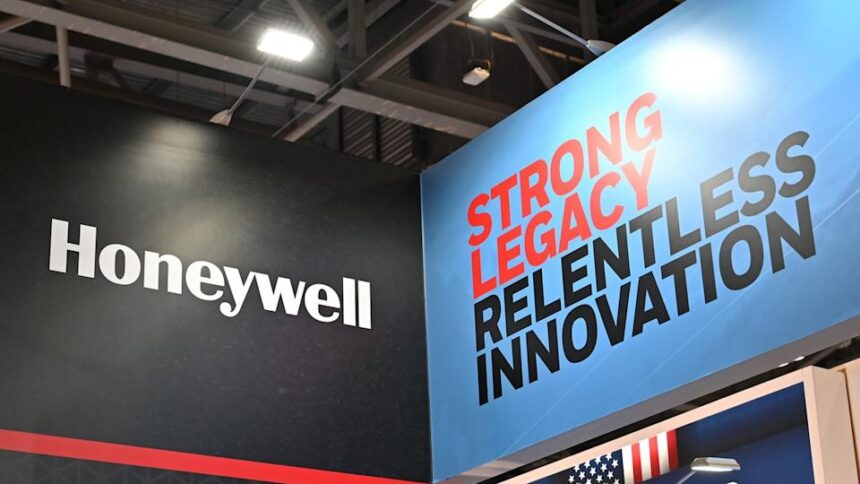
Honeywell has agreed to sell its Productivity Solutions and Services unit to Brady for $1.4 billion in cash, accelerating a broader restructuring strategy that aims to reshape the industrial conglomerate into more focused entities. The transaction underscores a decisive shift in portfolio strategy, and as NewsTrackerToday observes at this stage of the process, divestitures have become the central mechanism through which Honeywell is unlocking value ahead of its planned breakup.
The PSS unit, which produces barcode scanners, mobile computers, and printing systems for logistics and warehousing, generated approximately $1.1 billion in revenue in 2025. With around 3,000 employees and a global footprint, the business has long served as a steady but non-core contributor within Honeywell’s broader automation portfolio. Selling it at roughly 8x EBITDA signals both solid demand for logistics technology assets and a willingness by Honeywell to exit segments that no longer align with its long-term strategic priorities.
For Brady, the acquisition represents a transformative expansion. The company, with annual sales of about $1.5 billion, is effectively doubling down on industrial identification and workflow solutions. Management expects the deal to deliver double-digit earnings accretion within the first year, supported by at least $25 million in annual cost synergies within three years. Isabella Moretti, specializing in corporate strategy and M&A, points out that acquisitions of this scale often serve as inflection points – not incremental growth moves – particularly when they extend capabilities into adjacent high-demand sectors such as logistics automation.
The deal also reflects a broader consolidation trend in supply chain technology, where hardware, software, and data integration increasingly converge. As NewsTrackerToday frames this development within the industrial sector, companies are no longer competing on standalone products but on ecosystem control – from scanning and labeling to workflow optimization and analytics. Brady’s move positions it closer to that integrated model, while Honeywell steps back to focus on higher-margin, capital-intensive segments.
This divestiture forms part of a multi-year transformation at Honeywell. The company has already exited its personal protective equipment business and spun off its advanced materials division, while preparing to separate its aerospace and automation units into independent public companies by 2026. Liam Anderson, an expert in financial markets, emphasizes that such breakups often appeal to investors seeking clearer valuation narratives – conglomerate structures tend to obscure the performance of individual segments, while standalone entities allow capital to flow more efficiently.
Financially, the transaction appears manageable for Brady, which plans to fund the acquisition through a mix of cash and new debt, resulting in a net debt-to-EBITDA ratio of about 2.5x. That level remains within acceptable leverage thresholds for industrial firms pursuing strategic expansion, particularly when synergies and earnings accretion are expected to materialize quickly. Commentary tracked by NewsTrackerToday suggests that disciplined execution – not just deal pricing – will determine whether Brady can fully realize the projected benefits.
Honeywell’s restructuring now enters a more advanced phase, with fewer non-core assets remaining. The company’s leadership has framed these moves as the near completion of a long-term transformation, shifting from a diversified industrial model toward a more streamlined structure. As News Tracker Today captures in its ongoing assessment of industrial strategy shifts, the success of this approach will depend on whether sharper focus translates into sustained growth and improved market valuation across the newly separated businesses.