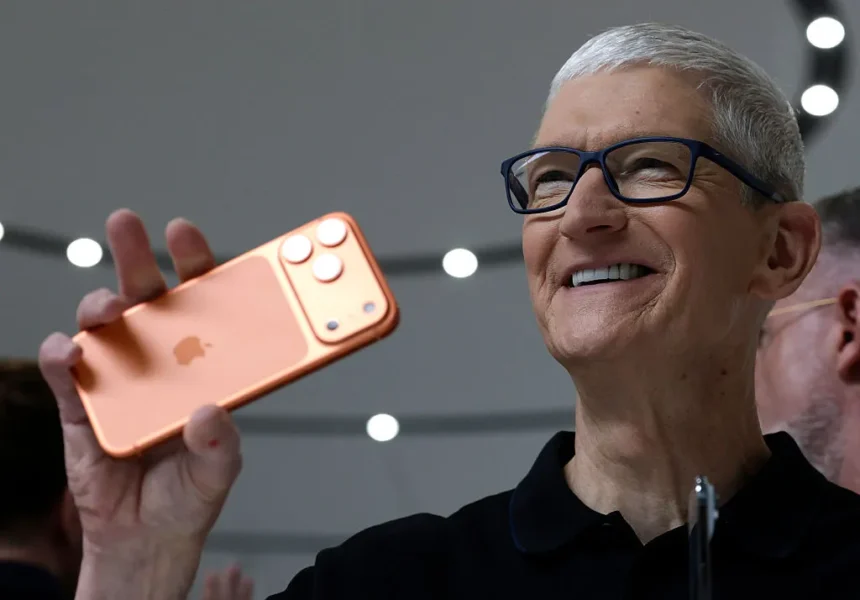
Apple is preparing for one of the most consequential leadership transitions in its modern history, with Tim Cook set to step down as CEO in September after 15 years in the role – a move that NewsTrackerToday views as a defining test of whether operational excellence or product vision will shape the company’s next era. His successor, John Ternus, inherits a business that remains financially dominant yet strategically exposed to shifting technological and geopolitical forces.
Cook’s tenure transformed Apple from a product-driven innovator into a precision-engineered global machine. While comparisons to Steve Jobs often emphasize product breakthroughs, Cook’s legacy lies in supply chain mastery, services expansion, and financial discipline. Apple’s services division now generates tens of billions annually, while its hardware ecosystem continues to anchor one of the most profitable business models in corporate history. At the same time, Cook’s operational strategy reshaped manufacturing networks and influenced trade flows – effectively turning logistics into a competitive advantage.
That foundation gives Ternus what many describe as a rare “running start.” Revenue growth remains resilient, margins are strong, and Apple’s brand continues to expand into adjacent areas such as entertainment and digital services. Yet stability at this scale introduces a different risk – overreliance on existing product cycles. NewsTrackerToday emphasizes that the company’s ability to sustain growth without a new category-defining product will increasingly come under scrutiny, particularly as innovation cycles in consumer technology accelerate.
Sophie Leclerc, who specializes in the technology sector, notes that Apple’s current challenge is less about incremental product upgrades and more about positioning within emerging ecosystems such as artificial intelligence. Unlike previous platform shifts, AI does not necessarily require a new device category – it can operate as a layer across existing hardware. This dynamic creates uncertainty around Apple’s traditional model, which historically relied on tightly integrated hardware and software experiences.
At the same time, macroeconomic and geopolitical pressures add complexity to the transition. Ethan Cole, who focuses on macroeconomics and central banks, highlights the growing fragmentation of global trade and the potential for supply chain disruptions. Apple’s deep reliance on international manufacturing networks – particularly in Asia – leaves it exposed to policy shifts, tariffs, and regional instability. NewsTrackerToday also points to the evolving relationship between major technology firms and political institutions, where regulatory pressure and strategic alignment increasingly influence corporate outcomes.
Artificial intelligence introduces another layer of strategic tension. Apple has taken a relatively cautious approach, favoring partnerships and incremental integration rather than aggressive standalone development. While this reduces execution risk, it raises questions about long-term differentiation. Competitors investing heavily in proprietary AI ecosystems may gain advantages in user engagement, developer ecosystems, and data-driven services – areas where Apple’s historically closed architecture could face limitations.
Capital allocation will likely play a central role in defining Ternus’s leadership. With substantial cash reserves, Apple has the capacity to pursue large-scale acquisitions or invest in entirely new product categories. Previous efforts – such as the long-rumored automotive initiative – demonstrated both ambition and the challenges of entering complex new industries. Whether the company chooses to deploy capital aggressively or maintain its disciplined approach will signal how it balances innovation with risk.
The transition also reflects a broader question about leadership archetypes in modern technology companies. Cook represented operational mastery – execution, efficiency, and scale. Ternus arrives with a reputation rooted in product development. The tension between these approaches may define Apple’s trajectory in an environment where technology cycles, regulatory landscapes, and global economics are all shifting simultaneously. As the handover approaches, News Tracker Today underscores that Apple’s position remains exceptionally strong – but no longer insulated. The next phase will test whether the company can evolve beyond its existing formula while preserving the operational discipline that made it one of the most durable businesses in the world.