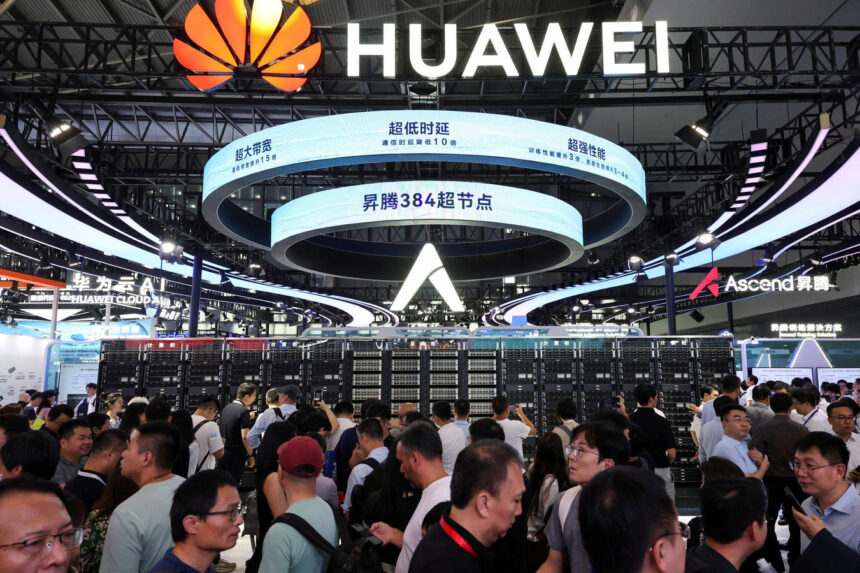
Huawei is preparing for a sharp surge in artificial intelligence chip revenue, with internal expectations pointing to growth of at least 60% this year. The projected rise – from around $7.5 billion to nearly $12 billion – reflects a wave of demand from Chinese companies increasingly turning to domestic suppliers, as NewsTrackerToday captures the scale of this shift unfolding across the semiconductor landscape.
At the core of this expansion is Huawei’s Ascend processor family, with the 950PR model already moving through large-scale production after its March rollout. Early uptake suggests that local alternatives are no longer viewed as secondary options, especially in environments where supply certainty and geopolitical alignment matter as much as raw performance. An upgraded 950DT version scheduled for later in the year points to an aggressive development cycle aimed at sustaining this momentum.
This rapid growth is closely tied to structural pressures shaping China’s technology sector. Sophie Leclerc, who specializes in the technology sector, emphasizes that restricted access to advanced foreign chips has effectively accelerated domestic innovation timelines. She highlights a shift in evaluation criteria – where stability of supply and ecosystem compatibility increasingly outweigh traditional benchmarking metrics.
Beyond immediate sales figures, the broader implications extend into how competitive dynamics are being redrawn. NewsTrackerToday tracks how Huawei’s expanding role in AI infrastructure is gradually reshaping procurement patterns, particularly among companies seeking to reduce dependency on external semiconductor ecosystems. The transition is not uniform, but the direction signals a more fragmented global market where regional capabilities gain strategic importance.
Ethan Cole, a specialist in macroeconomics and central banks, views this development through the lens of industrial policy. He notes that sustained capital flows into domestic chip production reflect a coordinated effort to shield critical technologies from external shocks. In his assessment, this approach may reinforce internal resilience while simultaneously increasing divergence across global supply chains. The interplay between demand, policy, and technological iteration places Huawei in a position that extends beyond commercial growth. NewsTrackerToday follows how this trajectory is influencing not only market share but also long-term standards and pricing leverage within AI hardware segments.
As new chip generations enter the market and production volumes expand, the outcome of this strategy will become clearer. News Tracker Today signals that Huawei’s current pace is not just about catching up – it is about redefining how technological ecosystems evolve when access, control, and scale converge under sustained pressure.