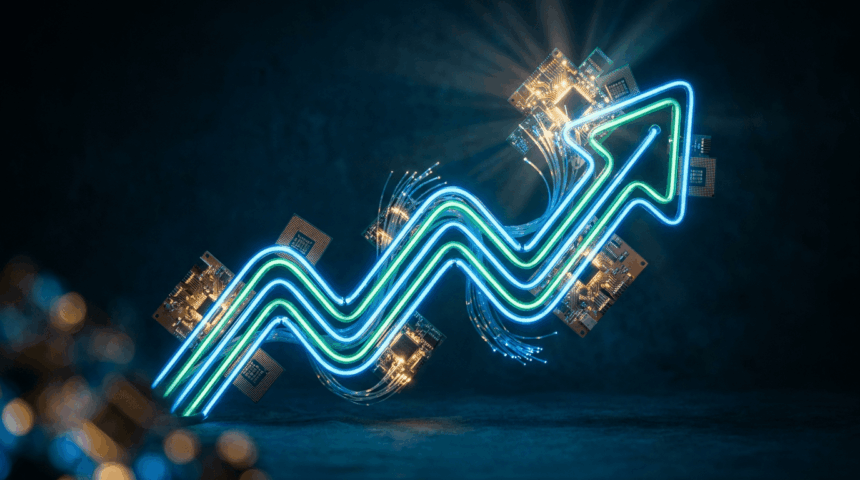
Wall Street’s enthusiasm for artificial intelligence has entered a new phase after Wedbush Securities managing director Dan Ives projected that the Nasdaq Composite could climb to 30,000 within the next year. That forecast implies roughly 14% upside from Friday’s close at 26,247.08 and reinforces a conviction that corporate earnings are doing more than just meeting expectations. As investors digest another strong technology reporting season, NewsTrackerToday identifies a market that increasingly treats artificial intelligence as a foundational investment cycle rather than a short-lived thematic trade.
The Nasdaq has already gained nearly 13% in 2026, while the PHLX Semiconductor Sector Index has surged 38% over the past month. Semiconductor leaders such as Nvidia, Intel, Apple and Alphabet have all posted double-digit gains as capital continues to flow into companies tied to data centers, chips, software and power infrastructure. Ives argues that the current environment resembles a memory super-cycle, with demand for advanced memory components far exceeding suppy as hyperscalers race to expand computing capacity.
Sophie Leclerc, technology sector specialist, sees the rally as a reflection of a broad industrial buildout rather than isolated enthusiasm for a handful of stocks. NewsTrackerToday traces how investors are moving beyond chipmakers themselves and into adjacent beneficiaries including cybersecurity firms, software vendors, networking providers and electricity infrastructure companies. That widening participation suggests that the market is assigning value to the entire architecture required to support large-scale artificial intelligence deployment.
Skepticism, however, has not disappeared. Michael Burry warned that the market’s fixation on AI increasingly resembles the final months of the 1999–2000 dot-com bubble, when rising prices became self-reinforcing. Paul Tudor Jones also expressed confidence that the bull market can continue, while cautioning that sharp valuation corrections could emerge along the way. Ethan Cole, chief economic analyst specializing in macroeconomics and central banks, notes that liquidity conditions and investor psychology can sustain elevated valuations longer than fundamentals alone might justify. NewsTrackerToday considers how this combination of genuine earnings growth and speculative momentum creates both opportunity and vulnerability.
What distinguishes the current cycle from earlier technology booms is the scale of capital expenditure now underway. Cloud providers, semiconductor manufacturers and utilities are investing billions to secure the computing power and energy needed to support next-generation AI systems. These commitments are translating into tangible revenue growth across multiple industries rather than remaining confined to conceptual promises.
If earnings continue to validate the aggressive spending underway, the Nasdaq’s march toward 30,000 may appear less extraordinary than it does today. News Tracker Today underscores that the central question is no longer whether artificial intelligence will reshape markets, but whether investors can navigate the inevitable volatility that accompanies one of the most significant technological investment cycles in decades.