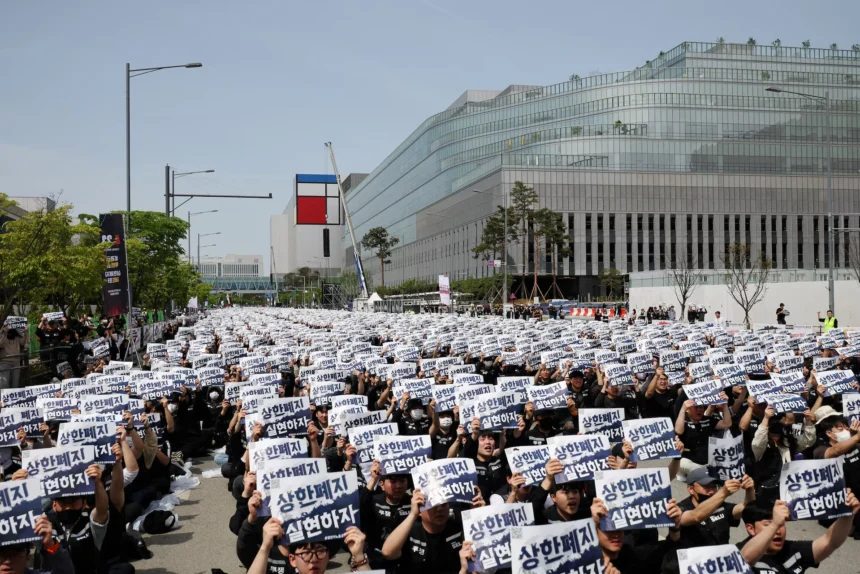
Samsung Electronics made a last-minute appeal to its largest labor union on Thursday, proposing a return to wage negotiations just as workers prepared to launch an 18-day strike that could begin on May 21. The standoff arrives at a particularly sensitive moment for the semiconductor industry, and NewsTrackerToday highlights that the dispute now carries implications far beyond a single company’s payroll structure.
At the center of the conflict is the union’s demand for a more transparent and formalized profit-sharing system. Union leaders argue that Samsung’s current bonus structure leaves employees at a disadvantage compared with rivals such as SK Hynix, whose staff have benefited more directly from the global surge in demand for advanced memory chips. The gap has become increasingly difficult to ignore as artificial intelligence spending drives extraordinary earnings across the sector.
Management has signaled a willingness to continue talks, while South Korea’s Labour Commission has urged both sides to resume government-mediated negotiations. Finance Minister Koo Yun-cheol warned that a prolonged strike would threaten exports, market stability, and national economic growth. NewsTrackerToday examines this warning as a reflection of how deeply semiconductor production has become intertwined with the country’s broader economic performance.
The numbers illustrate that dependence clearly. Semiconductors accounted for 37% of South Korea’s exports in April, up sharply from 20% a year earlier. This dramatic increase means that any disruption at Samsung Electronics could ripple through supply chains, trade balances, and investor sentiment. The company has reportedly begun reducing chip output as a precaution while preparing contingency plans to keep factories running. Sophie Leclerc notes that the dispute underscores a structural tension emerging across the global technology industry. As chipmakers commit unprecedented capital to support AI infrastructure, employees are demanding a larger and more transparent share of the resulting profits. Labor negotiations are becoming a strategic issue rather than a routine human resources matter.
The financial stakes are substantial. JPMorgan Chase estimated that the strike could affect Samsung’s operating profit by 21 trillion to 31 trillion won, while lost sales opportunities could total around 4.5 trillion won. NewsTrackerToday draws attention to the scale of these projections, which illustrates how heavily South Korea’s economic momentum now depends on a small number of semiconductor champions. Ethan Cole argues that when a single manufacturer dominates a crucial export sector, labor disputes can quickly evolve into macroeconomic events.
Samsung’s willingness to reopen negotiations suggests that management recognizes the broader consequences of a prolonged confrontation. The company is balancing immediate production risks against longer-term questions about how profits are shared during one of the most lucrative periods in semiconductor history.
If the union proceeds with its strike, South Korea could face a real-world test of how resilient its chip-centered growth model has become. News Tracker Today explores this confrontation as more than a wage dispute – it is a measure of whether the country’s most important industry can maintain stability while workers demand a clearer stake in the AI-driven boom.