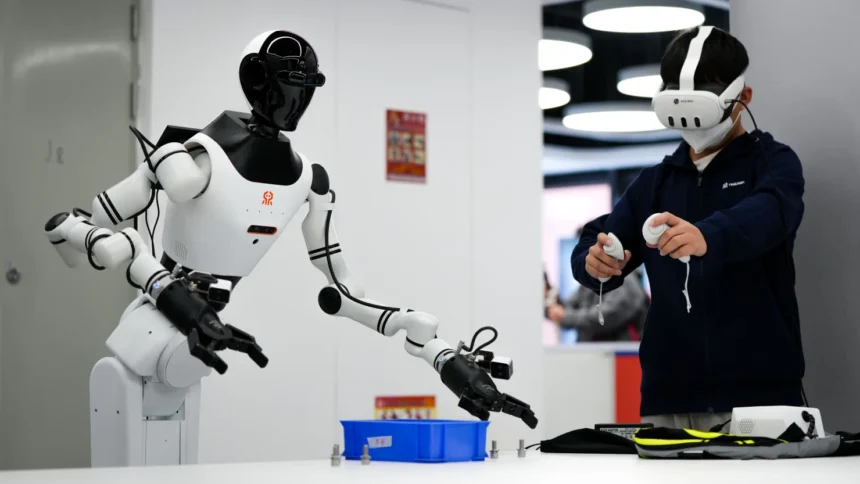
Inside a training facility in Beijing, Kenneth Ren guides a robot through the same grip sequence for the hundredth time that morning. He does not call himself a teacher. He calls himself an overseas solution expert at RealMan Intelligent Technology. The machine he works with cannot yet tie a knot or fold a jacket without help. But give it 10,000 more repetitions and, according to Ren, it will. This is how China trains its workforce of the future – by hiring humans to do the boring work first.
The scale of the operation is what NewsTrackerToday mapped first: across provinces like Anhui, Zhejiang, and Shandong, dozens of government-backed training centers now run around the clock, each one dedicated to converting human movement into robot data. The Hubei Humanoid Robot Innovation Center alone hosts more than 20 simulated environments, from hospital wards to kitchen counters, where trainers work one-on-one with machines, rehearsing tasks like grasping cups or wiping tables.
And the data problem driving all of this is genuinely hard. Unlike large language models, which trained on text scraped from the internet, humanoid robots need physical movement data – joint angles, force feedback, visual context – that cannot be downloaded. It has to be performed, recorded, and labeled. A robotic hand at RealMan runs through a new skill roughly 10,000 times before it learns it reliably enough to pick up an egg without cracking it. Three and a half out of every eight working hours yield usable data. The rest goes into corrections.
China accounted for approximately 90 percent of global humanoid robot shipments in 2025, according to tech research firm Omdia. Morgan Stanley projects that figure to translate into around 28,000 units sold domestically in 2026, roughly double the prior year. Beijing has embedded humanoid robotics as a strategic priority in the 15th Five-Year Plan, running from 2026 to 2030. This is not a startup sector – it is state infrastructure. NewsTrackerToday connects those two facts directly: government-backed training volumes and national output targets are not coincidental. They operate as a coordinated system.
Job platform Zhaopin reported that postings in China’s humanoid robot sector rose 409 percent in the first five months of 2025 compared with a year earlier, while the pool of job seekers expanded by 396 percent. A new professional category, robot trainer, now appears on Chinese employment contracts. Workers in these facilities describe themselves as ‘cyber-laborers,’ spending shifts in VR headsets and exoskeletons mimicking the movements they want machines to copy. For many of them, it is steady gig work. Repetitive. Replaceable, eventually.
Elon Musk told Tesla investors in January that Chinese competition in humanoid robotics will be the most serious the American industry faces, singling out manufacturing scale as Beijing’s key advantage. He credited Tesla’s Optimus hand design while acknowledging that China’s production capacity is unmatched. That tension – U.S. engineering versus Chinese volume – runs underneath every training shift at every robot school in Shandong. What News Tracker Today treats as the defining question here is not whether China can build enough robots, but whether the data they collect now creates a self-reinforcing advantage that compounds faster than any single hardware improvement.
When those 10,000 repetitions become standard and the trainer is no longer needed – and the Five-Year Plan’s language around ‘new quality productive forces’ implies that moment is planned for, not feared – human labor in this context becomes explicitly transitional. A bridge to a workforce that does not clock out. Whether that reads as industrial strategy or as something harder to name depends entirely on who is doing the reading.