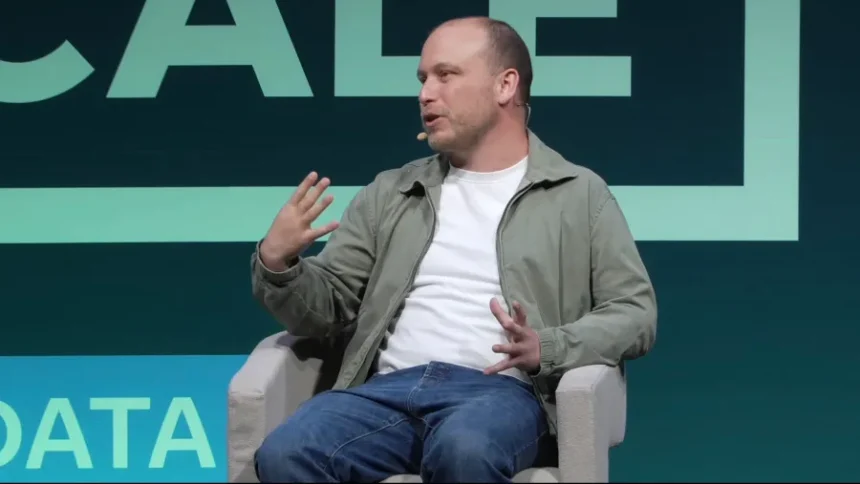
On Friday at Meta’s @Scale infrastructure conference, Claude Code creator Boris Cherny took the first audience question of his session, which came almost immediately and was not about infrastructure at all. It was: “Are loops the next hype cycle, or are they for real?” Cherny’s answer was unqualified. “Yes, they’re for real.” He then described a trajectory that covers the last two years of software development: “Two years ago, we wrote source code by hand. We started to transition so agents write the code. And now we’re transitioning to the point where agents are prompting agents that then write the code. As big as the step from source code to agents was, loops are just as important and as big a step.” The loop, in the way Cherny uses the term, is not a programming construct. It is a system configuration: you authorize a swarm of agents to work continuously in the background, without a fixed endpoint, stopping only when a sub-agent decides the goal is met.
Cherny described his own engineering workflow at Claude Code as an example of what running in loop mode actually looks like in production. One agent runs continuously searching for ways to improve code architecture. Another runs continuously identifying duplicated abstractions to unify. Both submit pull requests like human coders. Because the codebase keeps evolving, they never stop. The agents are not executing discrete tasks with defined start and end points. They are maintaining ongoing attention to open-ended improvement objectives inside a real production codebase. The shift that this represents – from managing agentic tasks to authorizing persistent background swarms – is what NewsTrackerToday opens on as the distinction that separates the loop concept from the agentic AI concept that has dominated the past 18 months of AI product announcements.
Sophie Leclerc, who covers the technology sector, maps the technical and commercial implications at length: “The standard agentic framework operates on a goal-setting model where a human defines the objective, the agent executes, and the human reviews the output. Loops remove that review cadence as the default mode and replace it with trust that the system is working productively without check-in. The non-deterministic stopping condition – a sub-agent decides when to stop, not a hard-coded rule – is the part that requires the most careful thinking. You are authorizing a system to make autonomous decisions about when it has accomplished an objective you may not have fully specified. That is a significant expansion of AI agency within an enterprise environment, and the companies that move to loop-based agentic workflows need governance frameworks that do not currently exist in most organizations.”
Cherny specifically contrasted the loop with the recursive function, a familiar programming construct where a function calls itself until a stopping condition is met. The key difference he highlighted: in a traditional recursive function, the stopping condition is explicit and deterministic. In an agentic loop, the sub-agent uses judgment to decide when the objective is sufficiently met. That judgment-based stopping is the capability that makes loops both more powerful and more demanding to deploy responsibly, and it is the architecture that NewsTrackerToday maps as the specific technical property driving both the excitement and the hesitation around the concept in production environments.
Liam Anderson reads the commercial timing: “Agents became a product narrative in 2025. Loops becoming real in 2026 means the product narrative just expanded. Every platform selling agentic AI – Anthropic with Claude Code, Microsoft with Copilot, Salesforce with Agentforce – now has a loop story to tell. Whether those stories represent genuine loop deployments in production or marketing repositioning of existing orchestration frameworks is the question enterprise buyers will be asking in the back half of the year.” The cost trajectory matters for the loop discussion. Models are getting faster and cheaper, which directly affects how viable it is to run agents continuously in the background for long periods. A loop that required $200 per day of compute six months ago might require $20 today. That price compression is what News Tracker Today catches as the enabler that makes Cherny’s argument about timing persuasive: the loop becomes commercially rational precisely when model costs drop to the point where continuous background execution is economically viable.
Does the enterprise software market move to authorize persistent agent swarms within 12 months, or does the trust question – can organizations delegate ongoing engineering judgment to systems whose stopping conditions are not fully predictable – create a slower adoption curve than Cherny’s conference-room confidence suggested? The history of AI adoption says the gap between demo-day conviction and production deployment runs longer than practitioners expect, and loops, which require higher trust than task-based agents, will likely run longer still. That is the question that NewsTrackerToday lands on as the test Cherny’s “Yes, they’re for real” will face over the next two years in production environments rather than in conference presentations.