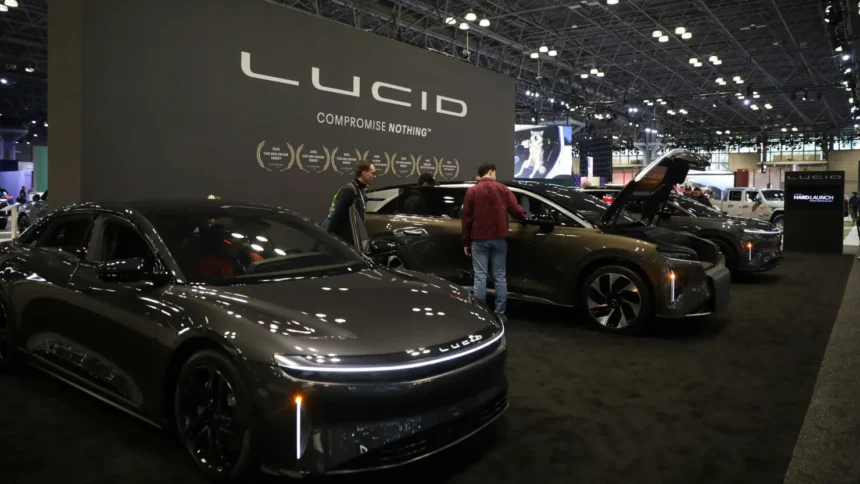
Lucid Motors announced on Monday it is cutting approximately 1,500 U.S. employees, roughly 18% of its workforce, as part of a restructuring plan its new CEO Silvio Napoli described as designed to “simplify the company, sharpen execution, and position Lucid to become more competitive over time.” The company simultaneously eliminated its second production shift at the AMP-1 factory in Casa Grande, Arizona, its primary manufacturing facility. COO Marc Winterhoff, who had served as interim CEO for more than a year before Napoli formally assumed the role on June 1, departed the company effective immediately, with the COO role itself eliminated. The company expects the restructuring to generate approximately $158 million in annualized savings and to complete by the end of Q3 2026. Approximately $32 million in cash charges will cover severance, benefits, and transition costs.
This is Lucid’s second significant workforce reduction in four months. In February, the company cut 12% of its staff. The combined impact of the two rounds, calculated from a pre-February baseline, represents a reduction of approximately 30% of the company’s U.S. workforce inside a single quarter. The two cuts together reflect a company in a fundamentally different financial position than its business narrative suggests: Lucid lost $2.7 billion on revenue of $1.35 billion in 2025, with negative free cash flow of $3.8 billion, roughly 31% worse than 2024. The company suspended its full-year forecast earlier in 2026, citing elevated inventory and the need to align production with anticipated demand, and also suspended its guidance citing the need for a full operational review by the incoming CEO. That operational review produced Monday’s 18% cut, and the combination of both rounds within a single year is what NewsTrackerToday anchors as the intensity of the restructuring relative to what EV startup narratives typically describe.
Liam Anderson on the financial position: “Lucid lost $2.7 billion in 2025 on $1.35 billion in revenue. Negative free cash flow of $3.8 billion. They’re burning more than twice their revenue annually. The $158 million in annualized savings from the latest cut is real, but it does not touch the structural loss rate. The Saudi Public Investment Fund is the reason this company still exists.” Saudi Arabia’s PIF, which owns the majority of Lucid, has continued to provide capital as the company burns through it. Without that sovereign backstop, two rounds of layoffs totaling 30% of the workforce in four months would be the opening act of a liquidity event rather than a turnaround plan. With it, the company can absorb the restructuring and continue developing the Cosmos, its planned mass-market crossover targeting under $50,000.
The Cosmos is the product around which Napoli’s entire turnaround strategy turns. Lucid currently produces the Air, a luxury sedan, and the Gravity SUV, both premium-priced vehicles competing in a segment with limited volume. The company has said Cosmos production could begin before year-end 2026, which would put it in direct competition with Tesla’s Model Y and Rivian’s R2 in the most competitive segment of the U.S. electric vehicle market. Lucid recently spotted its Cosmos prototype testing alongside a Model Y near its Arizona factory, which suggests development is progressing. Whether Napoli can execute a production launch while simultaneously reducing the manufacturing workforce and eliminating a production shift is the operational question that the Napoli logic NewsTrackerToday traces comes down to: simplify the cost structure first, then scale into the Cosmos with a leaner organization.
Sophie Leclerc, who covers the technology sector, reads the product and autonomy pipeline: “Lucid has a robotaxi partnership with Uber and Nuro slated to launch in San Francisco later this year. The Gravity SUV recently added hands-free driving capability. Those are legitimate product milestones. The question the robotaxi partnership raises in the context of 30% staff reductions is whether the technical teams working on those projects were protected from the cuts or absorbed into them. Lucid declined to say whether the robotaxi or autonomy programs are being scaled back, which is the kind of non-answer that carries specific information.” The senior engineering departures compound the concern: the SVP of powertrain and engineering and the chief engineer of the Cosmos midsize platform both left the company in June, before Monday’s announcement. Those are the two most technically critical roles for the product Lucid’s entire future depends on. Their exits alongside a workforce reduction that includes manufacturing, engineering, and contractors are what NewsTrackerToday puts as the backstop question: can Lucid actually launch the Cosmos in 2026 with the team it has now?
The most defensible near-term projection is that Lucid completes the Q3 restructuring on schedule, uses the $158 million in annualized savings to extend its cash runway by one to two additional quarters, and delivers the first Cosmos units in a limited production run before year-end, preserving its narrative of operational progress under Napoli. Whether the Cosmos launch can generate enough order volume to materially change the loss rate before the PIF grows weary of the subsidy is the longer question. The 2026 EV market in the United States remains pressured by regulatory changes under the current administration, including changes to purchase tax credits. None of that is within Lucid’s control, and the Cosmos must succeed in that environment regardless. The next production milestone – and Lucid’s ability to execute it with a smaller, recently restructured workforce – is what News Tracker Today closes on as the specific test the coming months will answer.