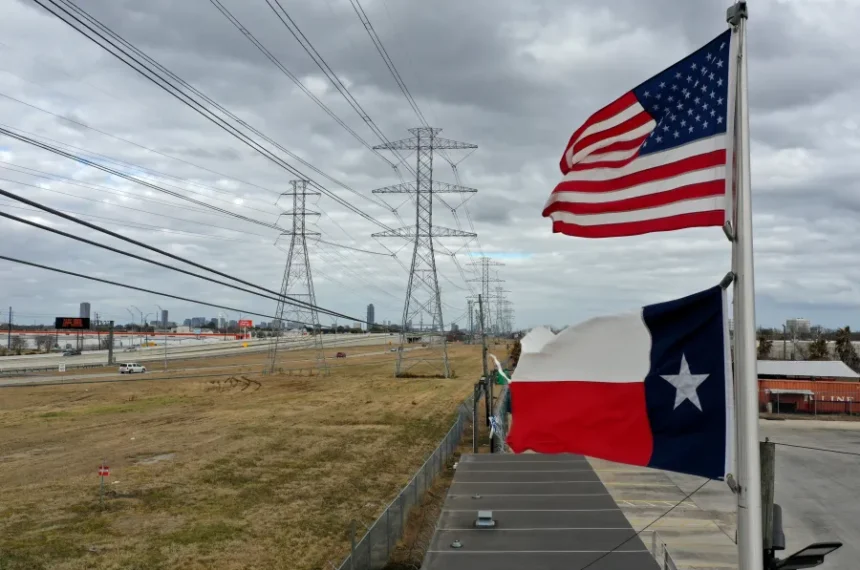
Microsoft and Chevron announced Monday they have signed a 20-year power purchase agreement under which Chevron’s subsidiary Energy Forge One, in partnership with investment firm Engine No. 1, will develop a natural gas power plant in Reeves County, West Texas, to supply electricity to a Microsoft-operated AI and cloud data center campus, with the complex known as Project Kilby and the gas plant designed to deliver approximately 2.67 gigawatts of generating capacity in its initial phases, potentially scaling to 5 gigawatts in later phases – a scale that Chevron described as “among the largest co-located natural gas power and data center developments in the U.S.” The generating capacity is being built from GE Vernova turbines alongside units from Caterpillar’s Solar Turbines division. Initial power delivery is targeted for 2028, with a final investment decision due by end of 2026. The initial estimated cost is approximately $7 billion. And this is the item that NewsTrackerToday picks up as the analytical frame the headline omits: Microsoft has spent years making public commitments to be carbon negative by 2030.
The infrastructure logic behind the announcement is not difficult to follow. Microsoft’s planned capital expenditure for 2026 stands at $190 billion, 61% more than 2025, with AI data centers as the primary destination. The company, along with Amazon, Alphabet, and Meta, faces a power procurement problem that renewable energy cannot currently solve at the pace and reliability required: data centers need dispatchable power, available on demand at any hour, in quantities that dwarf the output of solar and wind farms at comparable cost. Natural gas provides dispatchable power with the capacity factor that AI workloads require. A 20-year PPA provides certainty. Building off-grid, directly co-located with the data center and bypassing the ERCOT regional grid, eliminates exposure to grid congestion and ratepayers’ concerns about industrial load growth affecting electricity prices. Project Kilby is what energy economics produces when you apply $190 billion in capex and a reliability constraint to the power sourcing question, and it is what NewsTrackerToday follows as the commitment that the sustainability language in Microsoft’s annual reports has not yet caught up to.
Daniel Wu places the energy-tech partnership in a structural historical frame: “The relationship between major industrial consumers and the fossil fuel sector has historically followed a specific pattern: during periods of capital-intensive growth, industrial companies make deals with energy suppliers that lock in reliability over decades, then address the emissions afterward, often with offsets. The data center industry is following the same template. Microsoft, which signed the largest corporate renewable energy deals in history over the past decade, is now partnering with the world’s third-largest oil company to build natural gas infrastructure. The 20-year term is the signal: this is not a bridge solution. It is a commitment that runs to 2048.”
Microsoft’s president of Cloud Operations and Innovation Noelle Walsh described the project in terms of reliability and speed: “The rapid growth we’re experiencing in AI and cloud, driven by customer demand, requires energy infrastructure that can scale quickly and reliably.” Chevron president of New Energies Jeff Gustavson offered the fossil fuel framing: “AI is reshaping the global economy, and abundant, affordable, reliable energy is essential to fueling that transformation.” Neither statement addresses Microsoft’s formal 2030 carbon negative commitment. The $10 billion in projected state and local tax revenue and the estimated 2,000 jobs the project will support are the community benefit case the companies emphasized. The carbon footprint of 2.67 gigawatts of natural gas generation running continuously over 20 years is the number neither company emphasized.
Ethan Cole reads the energy market signal: “Chevron locking in a 20-year offtake agreement with a customer that cannot cancel without structural penalty is a capital allocation success. Permian Basin gas supply. GE Vernova turbines with established service contracts. Behind-the-meter installation that avoids grid fees. And a counterparty with a $190 billion annual capex program. For Chevron, this is a new business model: gas producer becomes contracted power provider to hyperscalers. That model scales if the next three hyperscalers make similar deals.” The behind-the-meter design – the power plant and data center directly connected, bypassing the public grid – answers the most common regulatory objection to data center power growth by removing the impact on local ratepayers. Jeff Gustavson noted that as the plant generates excess capacity, they plan to feed it into the grid to help stabilize it, which is what News Tracker Today reads as the 2030 target tension: the grid stabilization argument is how fossil-fuel-powered data centers get presented as net positive for energy infrastructure, even when they are net negative for decarbonization.
Three things to watch as Project Kilby develops: whether Chevron makes its final investment decision on schedule by end of 2026, which would confirm the deal converts from announcement to construction and begin the multi-year path to 2028 power delivery; whether Microsoft discloses how Project Kilby interacts with its carbon negative 2030 commitment, specifically whether the natural gas generation is offset, matched with renewable energy certificates, or simply carved out of the commitment as necessary infrastructure; and whether other hyperscalers – Amazon, Alphabet, Meta – announce comparable natural gas power agreements in the months following the Kilby disclosure, which would signal that the industry has collectively concluded that reliable fossil fuel power is a structural requirement for the AI buildout, regardless of stated sustainability targets. Project Kilby is a logical answer to an energy reliability problem, and it is what NewsTrackerToday marks as the moment the gap between AI infrastructure reality and corporate sustainability commitments became publicly visible in a single 20-year contract.