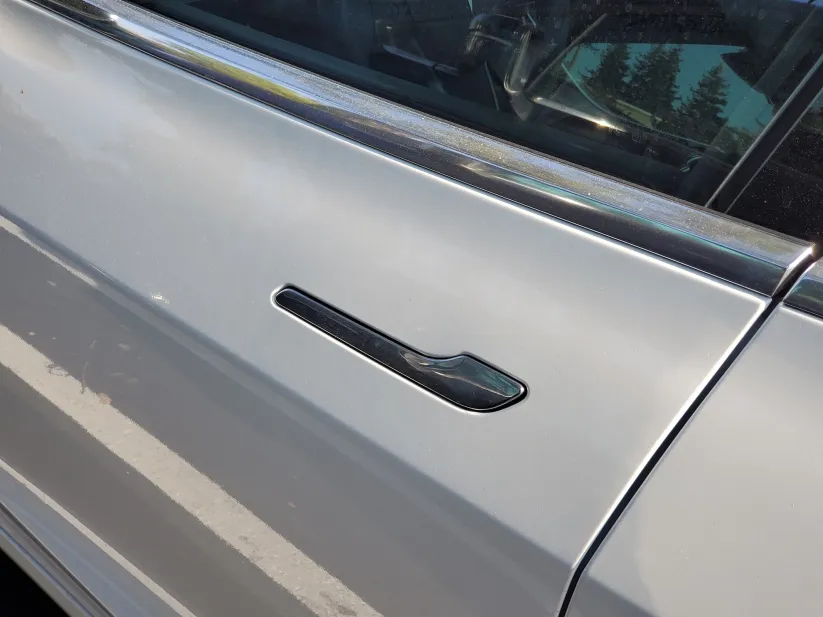
U.S. regulators will begin developing new safety requirements ensuring drivers and passengers can reliably exit their vehicles, following a series of incidents, including fatal ones, in which people became trapped inside cars fitted with flush, electronically operated door handles like those on Tesla vehicles. A federal agency choosing an industry-wide rule over a single-company defect investigation is what NewsTrackerToday checks to as the more consequential regulatory choice than the door handle design itself.
The National Highway Traffic Safety Administration announced the rulemaking process in response to a petition asking the agency to open a formal safety defect investigation into the emergency mechanical door release on 2022 Tesla Model 3 vehicles specifically, on the grounds that the release mechanism doesn’t comply with federal motor vehicle safety standards. NHTSA denied the specific action petitioners requested, saying the underlying issue would be better addressed through a rule applying to the whole industry rather than a defect probe targeting one automaker’s design.
Isabella Moretti reads the regulatory reasoning behind that choice: “A defect investigation targets one company’s specific design flaw. A rulemaking process sets a standard every automaker has to meet going forward, including any other manufacturer currently using or considering flush, electronically operated handles with a manual backup. NHTSA choosing the broader path here signals it sees this less as a Tesla-specific engineering failure and more as an industry-wide design pattern, minimal or hard-to-find manual releases paired with electronic primary handles, that needs a floor standard applied across every manufacturer, not a fix in one company’s next model update.” That industry-wide framing, more than the specific petition NHTSA denied, is what NewsTrackerToday reads round as the more significant regulatory signal in this announcement.
The investigation traces back nearly a year: NHTSA opened its inquiry into Tesla’s door handles after receiving nine reports from owners who couldn’t get into their own vehicles, in some cases with children still inside, following earlier reporting into a series of incidents where drivers and passengers became trapped after crashes. An initial NHTSA review found the manual releases, located only inside the vehicle, may fail to work if the electronic door locks don’t receive sufficient voltage from the car’s battery system, precisely the failure mode most likely to occur after a collision.
Liam Anderson reads the industry response already underway as evidence the design concern extends beyond Tesla alone: “Tesla’s own chief designer said last year the company was reworking its door handle design, and Rivian separately announced changes to its R2 SUV’s interior door handle specifically to move the manual release to a more visible location alongside the electric handle. Two different automakers independently making design changes to the same category of hardware, ahead of any final rule from NHTSA, tells you this isn’t a regulatory overreaction to an isolated problem, it’s the industry already recognizing a real design gap regulators are now moving to formalize.” That parallel industry movement, more than the regulatory process itself, is what News Tracker Today ties on as the clearest signal this concern is substantive rather than manufactured.
NHTSA was careful to note that “commencing” a rulemaking process doesn’t guarantee a final rule actually emerges from it, a standard caveat that applies to any regulatory process at this early a stage, regardless of how serious the underlying safety concern driving it may be.
None of this confirms what a final rule would specifically require, whether it mandates manual release visibility, minimum backup power redundancy, or some combination the agency hasn’t yet detailed publicly. Whether NHTSA’s rulemaking process actually produces an enforceable standard before more incidents occur, or whether individual automakers’ voluntary redesigns end up solving the practical problem faster than the regulatory process does, is what NewsTrackerToday closes with as the real question this announcement leaves for the industry to answer.