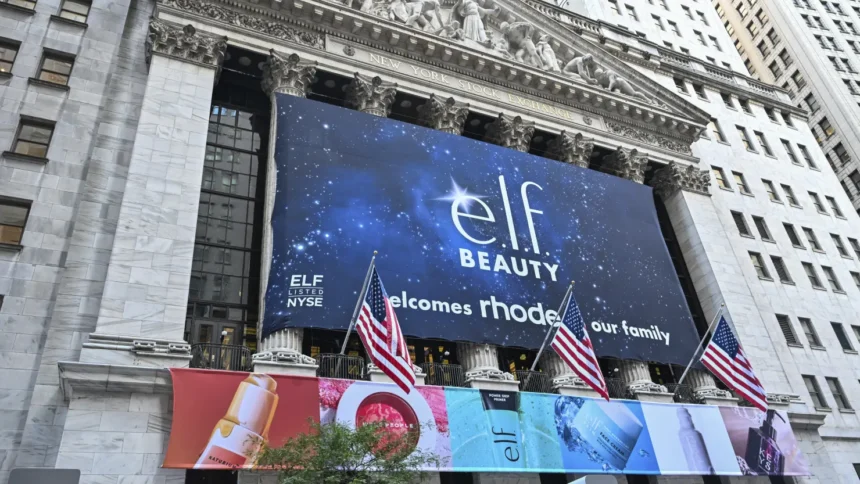
The beauty industry is entering one of its most fascinating transitions in years: influencer-led brands are no longer just marketing phenomena – they’re becoming full-scale business strategies. The recent acquisition of Hailey Bieber’s Rhode by E.l.f. Beauty marks this turning point. At NewsTrackerToday, we see this not as a routine portfolio expansion, but as a strategic realignment of E.l.f.’s business model in a market where growth is slowing and attention is the new currency.
Despite Rhode’s impressive performance – adding about $200 million in sales this fiscal year – E.l.f.’s forecast disappointed investors. The company expects annual revenue between $1.55 and $1.57 billion, implying 18–20% growth, well below the $1.65 billion analysts anticipated. Adjusted earnings per share are projected at $2.80–$2.85, missing Wall Street’s $3.58 consensus. Shares fell nearly 29% after the announcement. E.l.f.’s decision not to issue guidance last quarter likely contributed to the mismatch between expectations and reality.
CEO Tarang Amin defended the results as “strong and resilient,” emphasizing that Rhode is more than an add-on – it’s a long-term growth engine that could define the company’s trajectory for the next decade. At NewsTrackerToday, we note that the $1 billion Rhode acquisition is already scaling rapidly, with sales up nearly 40% year-over-year. Its September rollout in Sephora became the largest launch in the retailer’s North American history, surpassing even major past collaborations.
Still, behind the success lies structural pressure. E.l.f.’s gross margin declined by 1.65 percentage points, and net income plunged 84%, driven largely by new tariffs on Chinese imports imposed by the Trump administration. With China supplying much of E.l.f.’s raw materials, the impact has been significant. The company has raised prices by $1 effective August 1 and expects profitability to improve in the second half of the year.
According to Isabella Moretti, a corporate strategy analyst at NewsTrackerToday, the Rhode deal illustrates how mainstream brands seek to “inject fresh blood” through influencer-driven labels: “Rhode isn’t just diversification – it’s scalable influence. When a company acquires not only a product but a community, it’s effectively buying a new form of capital – cultural capital.”
Chief economist Ethan Cole believes such acquisitions show the maturity of the consumer-goods sector: “E.l.f.’s financials may have dipped, but the market is shifting its valuation lens. It’s no longer just about profitability – it’s about resilience and trust. That’s the new economy of consumer relevance.”
In the long run, the success of Rhode’s integration will define E.l.f.’s ability to compete with global players. Expansion into the UK and Asia appears to be the logical next step, though rapid scaling could risk diluting brand control and operational efficiency.
At News Tracker Today, we view the Rhode acquisition as a stress test for the entire beauty sector: can large corporations not only buy attention but sustain it? If E.l.f. manages to merge Rhode’s creative energy with its logistical and digital infrastructure, it won’t just maintain growth – it will set a new standard for the industry. But if execution falters, the company risks becoming another case study in how viral success doesn’t always translate into structural longevity in a world where trends evolve faster than quarterly reports.