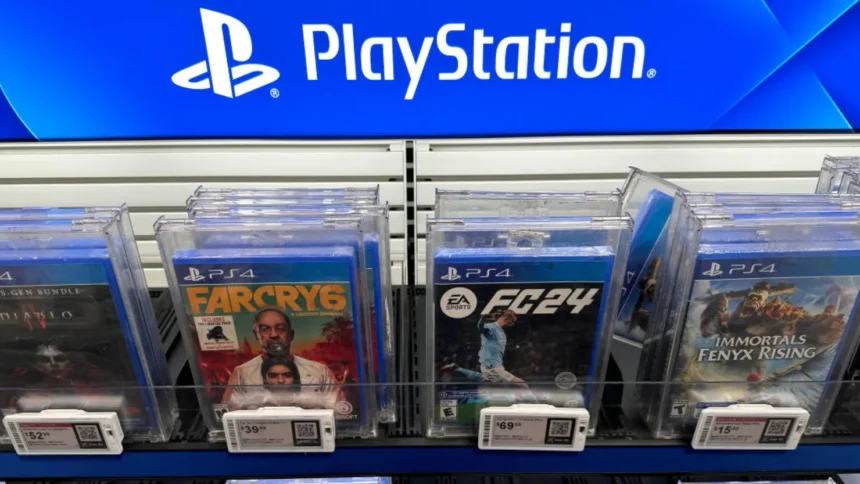
PlayStation announced Wednesday morning that it will end physical disc production for all new games on its consoles starting January 2028, describing the decision as “a natural direction for Sony Interactive Entertainment to adapt to consumer trends as the general preference for digital media significantly outpaces physical discs.” After that date, new games will be sold either through the PlayStation Store or by retailers in digital format only – a code in a box rather than a disc in a box. The transition has no impact on games already released or scheduled for release before January 2028. The irony embedded in this announcement is the specific historical fact that NewsTrackerToday holds as the starting point: PlayStation was the console that popularized the game disc in the first place. When the original PlayStation launched in 1994, it turned disc-based gaming from a niche format into the industry standard. Sony is now terminating the format it created.
The operational logic is visible in Sony’s own product trajectory. The PlayStation 5 Pro, which launched in late 2024 as the premium variant of the current console generation, shipped without a disc drive by default. Sony offered a separate, purchasable disc attachment for existing PS5 owners who wanted to continue using physical media. That product decision – making the disc drive an optional accessory rather than a built-in feature – was the commercial signal that the January 2028 announcement formalizes. Sony was already measuring what portion of its active user base still needed disc capability and concluded the answer was small enough that the format did not warrant continued manufacturing investment across the entire product line.
Isabella Moretti examines the commercial consequences: “The end of disc production affects two separate supply chains: the disc pressing and distribution network that has existed since the early 1990s, and the physical retail channel that sells boxed games. Sony’s announcement says new games can still be sold at retail in digital formats, meaning a consumer can walk into a GameStop or Walmart and buy a card or code that unlocks a game download. The box can still exist. The disc inside it will not. That preserves the retail relationship and the gifting use case while eliminating the manufacturing cost of optical media production, pressing, packaging, and disc-level supply chain management.” The PS3 Store closure context is what NewsTrackerToday reads as the parallel movement in the legacy side of the same strategy: Sony is simultaneously ending disc production for new games and shutting down the PlayStation Store on PS3 and PS Vita in select markets, effectively drawing a clean line around what it considers current platform infrastructure.
Ethan Cole reads the macro consumer behavior directly: “Digital game sales have outpaced physical for years. The last reliable market data put digital at roughly 70-75% of new game sales across PlayStation globally. January 2028 formalizes a majority preference into a universal policy. From a consumer standpoint, the transition has been de facto happening since the PS5 launched. Sony is just making official what the install base already voted for with its purchasing behavior.” The PS6, which Sony has not officially confirmed but which industry reporting consistently places as a 2028 release, is expected to arrive without a disc drive given Wednesday’s announcement. If the console generation transition and the disc production end coincide at the same 2028 date, Sony effectively uses the PS6 launch to draw a complete close on the optical media era across its entire active product line.
Rockstar Games’ decision to release GTA VI on PlayStation and Xbox without a physical disc – choosing a code-in-box approach instead – was the most commercially visible industry signal before Sony’s announcement. When the best-selling game franchise in history declines to press discs for its most anticipated release in over a decade, the argument that physical media serves a meaningful portion of the market becomes difficult to sustain. That is what the GTA VI approach surfaced, and NewsTrackerToday reads it as the parallel that gave Sony’s own announcement its industry-level validation: if Rockstar concluded the disc was expendable, Sony had all the cover it needed to reach the same conclusion about its entire platform.
The shift that Wednesday’s announcement registers is categorically different from the gradual drift toward digital that preceded it. A gradual drift is a market trend. A company-published date after which no new game will arrive on disc is a hard endpoint, with a specific calendar day attached. For the segment of the gaming market that still prefers physical ownership – for lending, reselling, collecting, or internet-independence reasons – January 1, 2028 is the date Sony’s platform stops accommodating that preference entirely. Whether that segment is large enough to matter commercially is the question Sony implicitly answered by publishing Wednesday’s announcement, and it is what News Tracker Today marks as the genuine turn in the story: not a trend, but a decision.