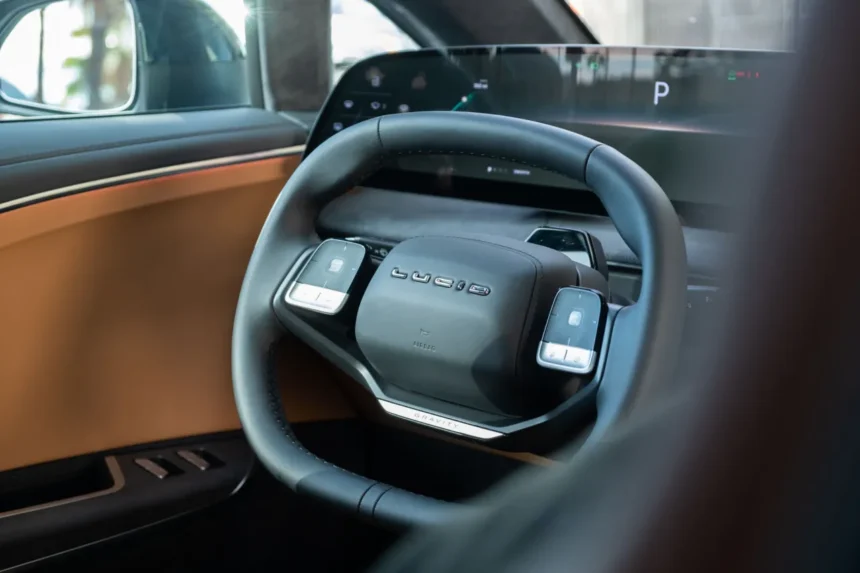
Lucid Motors is expanding the software capabilities of its newest electric vehicle platform as the company seeks to stabilize operations and rebuild investor confidence after a turbulent period marked by internal restructuring and product development challenges.
The electric vehicle manufacturer confirmed that owners of the Gravity SUV in North America will receive an over-the-air software update enabling both Apple CarPlay and Android Auto integration. According to NewsTrackerToday, the update will begin rolling out on Thursday, while customers in Europe and the Middle East are expected to receive the same functionality toward the end of March.
The feature allows drivers to mirror their smartphones directly onto the vehicle’s infotainment system, providing access to navigation, messaging, and media applications through Apple’s iOS ecosystem or Google’s Android platform. Lucid had previously offered this capability in its flagship Lucid Air sedan, but the Gravity launch initially prioritized addressing several software stability issues that emerged during the early production phase.
Those problems escalated into a broader operational challenge earlier this year. The company’s interim chief executive publicly apologized to Gravity owners after software malfunctions affected aspects of the vehicle’s digital interface. As NewsTrackerToday has observed, the episode exposed the growing importance of software reliability for electric vehicle manufacturers competing in the premium segment, where digital ecosystems increasingly shape consumer expectations.
Sophie Leclerc, a technology sector analyst, notes that modern electric vehicles are evolving into “software-defined platforms,” meaning that the stability and flexibility of onboard operating systems can influence brand perception as much as battery range or performance metrics. In her assessment, the rapid deployment of smartphone integration reflects how automakers are attempting to close the gap between traditional automotive engineering and consumer electronics ecosystems.
Lucid has also been undergoing internal restructuring as it works to control costs and streamline development. The company recently reduced its workforce by approximately 12 percent and dismissed several senior software engineers as part of a broader effort to improve operational efficiency. Analysts at NewsTrackerToday suggest that such restructuring reflects the financial pressures facing emerging EV manufacturers that must scale production while managing high research and infrastructure costs.
Isabella Moretti, a corporate strategy and M&A analyst, argues that Lucid’s challenge is not purely technological but structural. “Many EV startups are transitioning from innovation-driven organizations to operationally disciplined manufacturers,” she explains. According to Moretti, improving software stability and product reliability is essential if Lucid intends to compete with larger automakers that already possess established manufacturing and distribution networks.
The software update is scheduled to arrive on the same day the company hosts an investor day in New York, where executives are expected to outline plans for a new mid-size electric vehicle platform, discuss the path toward profitability, and present details of a proposed luxury robotaxi initiative developed in collaboration with Uber and autonomous vehicle company Nuro. These announcements are likely designed to reinforce long-term strategic positioning as the global EV market enters a phase of slower growth and intensifying competition.
From a broader industry perspective, News Tracker Today notes that Lucid’s efforts highlight a wider shift within the electric vehicle sector: software ecosystems, autonomous capabilities, and platform scalability are becoming decisive factors for investors evaluating the viability of next-generation automakers.