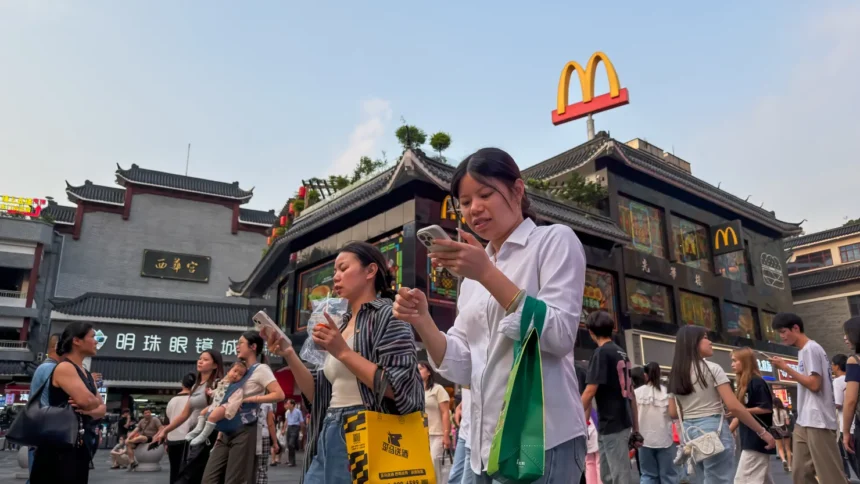
McDonald’s is accelerating its expansion across China at a time when many international consumer brands struggle to maintain relevance in the country. The fast food chain aims to reach 10,000 mainland stores by 2028, signaling confidence in a market where weaker spending and rising local competition have forced numerous foreign companies onto the defensive. In this environment, NewsTrackerToday tracks how McDonald’s continues turning affordability and emotional familiarity into competitive advantages.
The contrast with brands such as Starbucks, Nike, and LVMH has become increasingly visible. Domestic Chinese brands have improved quality while appealing to national sentiment and tighter household budgets, eroding the premium aura once attached to foreign labels. McDonald’s, however, occupies a distinct space within the market by combining global consistency with aggressive value positioning.
The return of classic milkshakes at selected stores demonstrates how strongly the company remains connected to consumer nostalgia. For many Chinese customers who first encountered Western fast food during the country’s rapid economic opening in the 1990s, McDonald’s still carries emotional weight beyond the product itself. At the same time, NewsTrackerToday explores how the company blends that nostalgia with localized innovation to stay relevant to younger consumers seeking novelty and affordability simultaneously.
Its menu strategy reflects that balancing act. Limited-time local products sit alongside core global items, allowing the brand to evolve without losing recognition. Budget-friendly combinations also reinforce McDonald’s appeal during a slower economic cycle, particularly as consumers become more selective about discretionary spending. Isabella Moretti, a specialist in corporate strategy and M&A, views McDonald’s performance in China as evidence that adaptation matters more than prestige alone. She argues that several multinational brands misread the market by leaning too heavily on legacy reputation, while McDonald’s focused on embedding itself into everyday routines through accessibility and operational consistency.
The structure of the China business adds another layer of stability. A majority stake belongs to local investor Trustar, strengthening domestic alignment and helping accelerate store growth across the country. In parallel, NewsTrackerToday examines how this localized ownership model may provide operational flexibility that many other foreign consumer brands lack in China’s increasingly competitive retail environment.
Consumer behavior across China continues shifting toward value-oriented spending, but low prices alone no longer guarantee loyalty. Reliability, familiarity, and perceived quality now carry equal importance in purchasing decisions. McDonald’s appears to have adapted to that reality faster than many of its global peers, a transition News Tracker Today emphasizes as one of the clearest examples of how foreign brands can still expand successfully inside China despite mounting pressure across the broader consumer sector.